Explore prediction market psychology: how anchoring, herd behavior, confirmation bias, loss aversion, and overconfidence distort prices and trader decisions.
- Sides Team
- /July 23, 2026
- /8 min read
Why Prediction Market Prices Diverge From True Probabilities
Prediction markets are designed to aggregate belief into price. A contract trading at 0.65 should, in theory, reflect a 65 percent chance the event occurs. Yet anyone who watches these markets sees prices swing, stall, and sometimes sit obviously wrong for hours. The gap between market price and true probability is not always explained by new information. Often, it is explained by the traders themselves.
Cognitive biases are systematic errors in thinking that distort judgment. In prediction markets, those errors do not stay private. They become order flow. When enough participants anchor to an opening price, chase a trending contract, or dump positions after a single headline, the result is prediction market prices diverging from true probabilities. Understanding prediction market psychology means recognizing how individual mental shortcuts scale into collective mispricings.
This article focuses on the internal forces that bend prices away from rational estimates. For the external side of price formation—news, research, and sentiment shifts—read about prediction market price drivers separately. If you are newer to execution mechanics, you can also review how prediction markets work and how decentralized betting works in practice.

Behavioral Finance and Prediction Markets: Brief Context
Research on behavioral finance and prediction markets grew from a simple observation: real humans do not match the rational-agent model. Kahneman and Tversky's work on heuristics and biases showed that people rely on mental shortcuts under uncertainty. Prediction markets are uncertainty engines. Traders must estimate probabilities, weigh evidence, and decide under time pressure. That environment is fertile ground for the exact shortcuts behavioral economists documented.
The key distinction is scope. This article covers internal trader psychology. External catalysts also reprice contracts, and the mechanics of order flow, liquidity, and arbitrage matter too. The psychology is what happens between the trader's ears before the order is placed.
Anchoring Bias: Why Traders Get Stuck to Initial Prices
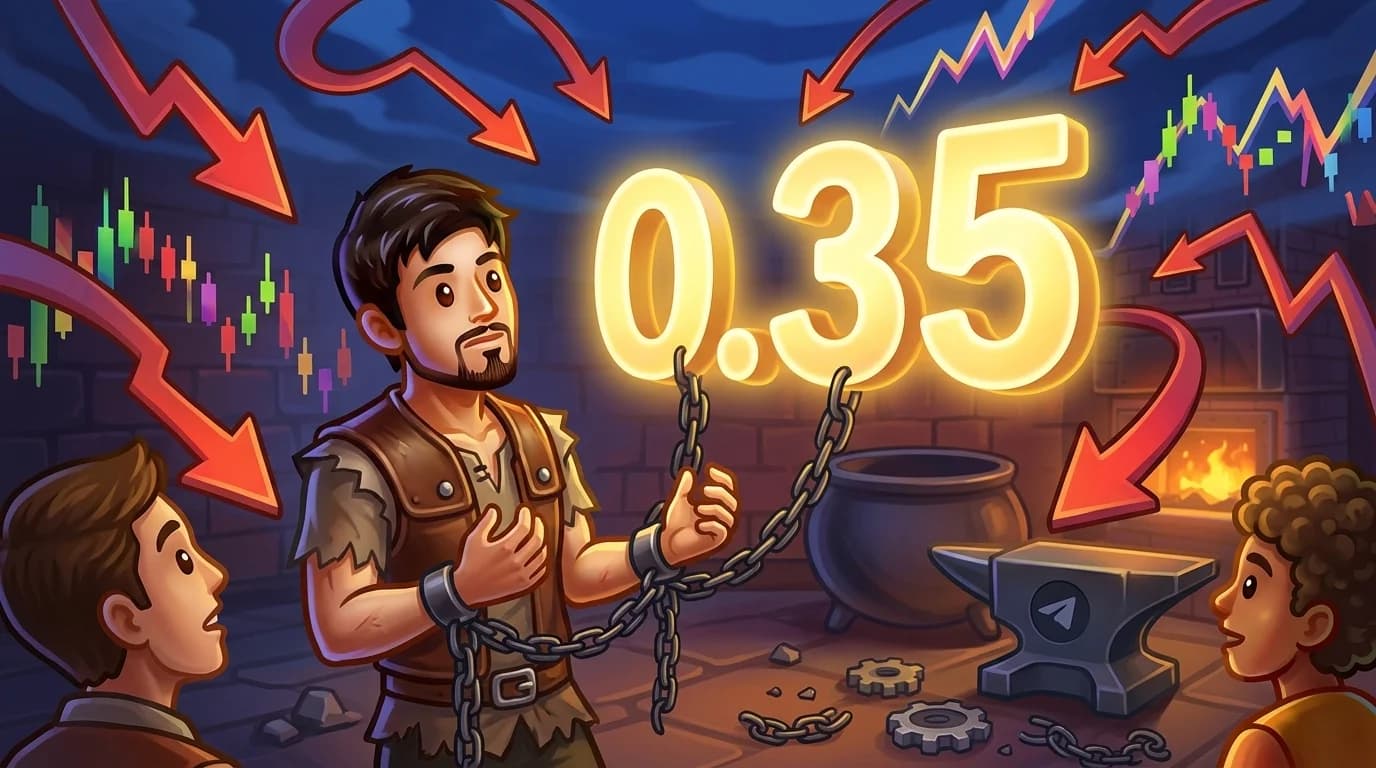
Anchoring behavior in prediction markets starts with the first number a trader sees. When a contract opens at 0.35, that figure becomes a reference point. Subsequent prices are judged relative to it, not relative to the underlying event. A move to 0.50 feels "expensive" if you anchored at 0.35, even if new information justified the increase. Conversely, a drop to 0.25 feels like a bargain, even when the true probability fell to 0.15.
This is why traders anchor to initial prices in prediction markets: the opening price, or the first price at which they considered entering, becomes a psychological benchmark. Rational updating means revising your estimate based only on new evidence. Anchoring means revising it based on where you started.
Symptoms of anchoring:
- Comparing current price to your entry price rather than to the event likelihood
- Refusing to buy higher than the opening print even when the event's odds improved
- Using the price you remembered last week as fair value today
Herd Behavior and Crowd Psychology in Prediction Markets
Herd behavior dynamics in prediction markets are visible in every sharp rally or selloff without fresh news. One trader buys; another sees the price tick up and buys too, interpreting the movement as information rather than noise. Soon the contract is up ten cents on nothing but confidence in confidence itself.
Crowd psychology and prediction market mispricings feed on visibility. Most platforms show recent trade size, price history, and comment threads. That transparency is useful, but it also creates social proof. If others are buying, it feels safer to buy. If the discussion thread is bullish, the bullish case feels stronger. The result is a tension between prediction market sentiment vs probability, where price starts tracking mood instead of math.
Contrarian position psychology in prediction markets demands stepping away from the crowd when the crowd's reasoning is circular. That is emotionally costly. Humans are wired for conformity. Trading against the herd means accepting short-term isolation for a long-term edge.

Confirmation Bias: When Belief Distorts Market Odds
Traders display confirmation bias in prediction markets when they overweight evidence that supports their position and ignore evidence that undermines it. A trader long on "Yes" at 0.60 will hunt for tweets, headlines, and analyst quotes that support a higher probability. They will dismiss contradictory data as noise or bad sourcing.
This bias is especially dangerous because prediction market contracts resolve in binary fashion. You are either right or wrong. Clinging to confirming evidence while filtering out disconfirming evidence does not change the eventual outcome; it only changes how much you lose before settlement.
How confirmation bias distorts market odds at scale: when a large cluster of traders shares a political, sporting, or cultural affiliation, the order flow becomes one-sided. The price then reflects the community's belief, not the event's likelihood. The market turns into an echo chamber.

Recency Bias and the Availability Heuristic
Recency bias affects prediction market odds by making traders treat recent events as more probable than base rates suggest. If a team won its last three games, traders inflate its contract even if the opponent changed, the venue changed, or the prior wins involved luck. The recent memory is vivid, and vividness masquerades as probability.
The availability heuristic works similarly. If a trader just read a dramatic story about a market crash, they will overestimate the chance of another crash. If a political scandal is trending, the related contract jumps. The information is available, so it feels likely.
These mental shortcuts skew prediction market pricing and are particularly active around breaking news cycles, social media spikes, and post-event overreactions where traders project the just-witnessed outcome forward.

Loss Aversion and Overconfidence: Asymmetric Risk Responses
Traders in prediction markets experience loss aversion as a sharp asymmetry: the pain of losing $100 feels stronger than the pleasure of gaining $100. This creates irrational holding and exiting patterns. A trader down on a position will hold through deteriorating odds, hoping to break even. A trader up on a position will cash out too early, locking in a small win to avoid the risk of reversal.
Meanwhile, overconfidence in prediction markets leads traders to act too frequently and with too much conviction. Overconfident traders misattribute lucky wins to skill. They build mental narratives around their edge and size positions beyond what the evidence supports. The combination of loss aversion and overconfidence in prediction markets is toxic: fear locks in bad positions, while ego inflates new ones.

How to Avoid Emotional Trading: A Practical Bias-Check Framework
Emotional entries and exits in prediction markets are not inevitable. They are habits, and habits can be checked. Here is a practical framework to avoid emotional trading in prediction markets:
Pre-trade checklist
- Write down your probability estimate before looking at the current price. This neutralizes anchoring.
- List one piece of evidence that would prove you wrong. This fights confirmation bias.
- Check whether the price moved in the last hour without news. If yes, herd behavior may be active.
- Ask: would I take this position at the same size if I were already down on a different contract? This exposes loss aversion.
Post-trade review
- Compare your pre-trade estimate to the final outcome, not to your profit and loss. Calibrate your judgment, not your luck.
- Note moments you exited because of price movement rather than information change. Those are emotional exits.
For sizing and capital protection, disciplined position sizing is the structural backstop against psychological mistakes. You can read more about that in our guide to prediction market bankroll management.

Building the Discipline to Trade Contrarian
Contrarian trading in prediction markets is not mere opposition for its own sake. It is buying when the crowd's fear or greed has bent the price away from your independent estimate. The psychology behind prediction market overreactions is that humans coordinate on narratives. When the narrative is wrong, the price is wrong.
To build discipline:
- Establish your estimate first. Then look at the market.
- Set conditions for entry and exit in advance. Decision-making ahead of time is more rational than decision-making in the moment.
- Accept being early. Markets can stay irrational longer than you can remain solvent. A biased price does not correct on your schedule.
- Use limit orders and understand true transaction costs. Our guide to prediction market liquidity covers spreads, order books, and slippage in detail.
When you identify a bias-driven mispricing and want to take a disciplined contrarian position quickly, mobile access matters. Sides.Trade operates as a fast-access execution layer for psychologically prepared traders, letting you enter or exit directly from Telegram without the friction of switching contexts.

Bias Quick-Reference Table: Symptoms and Market Effects

Risk and Limitations
Recognizing cognitive biases in prediction markets does not remove risk. Markets can remain irrational longer than individual traders can remain solvent. A biased price can become more biased before it corrects. There is no guarantee that identifying a mispricing leads to profit, and no psychological framework eliminates the chance of loss.
Some traders attempt to capture these deviations through prediction market arbitrage, though execution costs and timing often erase the apparent edge. This article describes common patterns in prediction market trader psychology as an educational awareness tool, not a system for guaranteed outcomes.
Frequently Asked Questions
FAQs
Cognitive biases turn individual mental shortcuts into collective order flow. When traders anchor, follow herds, or confirm existing beliefs, prices diverge from true probabilities and create tradable distortions.
Prices diverge when trader behavior introduces noise. External information moves prices toward accuracy; internal biases like overconfidence, loss aversion, and recency often push prices away.
The most common are anchoring, herd behavior, confirmation bias, recency bias, loss aversion, and overconfidence. Each distorts a different phase of the trade lifecycle, from entry to exit.
Use a pre-trade checklist: write your probability estimate before seeing the price, list evidence that would prove you wrong, and check for newsless price movement. Review trades based on process, not profit.
Herd behavior is when traders copy the visible actions of others, treating price movement as new information. It creates momentum and mispricings that can detach from the underlying event probability.
The first price seen becomes a psychological benchmark. Traders judge later prices relative to that anchor rather than updating their estimate based solely on new evidence.
Yes. Loss aversion causes traders to hold losing positions too long and exit winning positions too early. The pain of a loss outweighs the satisfaction of an equivalent gain.
Confirmation bias leads traders to seek and overweight evidence that supports their position. When many traders share the same bias, order flow becomes one-sided and prices reflect belief instead of likelihood.
Absolutely. Traders overvalue recent events and project them forward, inflating or depressing contract prices beyond what base rates and context justify.
Form an independent probability estimate first, then compare it to the market price. Enter only when the gap is large enough to justify the risk, and use pre-set rules to avoid emotional exits.