Learn how prediction market liquidity, spreads, order books, and slippage determine your true transaction cost on Polymarket, Kalshi, and similar platforms.
- Sides Team
- /July 15, 2026
- /10 min read
Prediction market liquidity is the distance between the price you see on screen and the price you actually pay to enter or exit a position. It is not just trading volume or open interest; it is the gap between quoted price and realized price that determines your true transaction cost. If you ignore that gap, every trade erodes value before the event even resolves.

This guide breaks down the mechanics that create that cost: bid-ask spreads, order book depth, and slippage. You will learn how to read a prediction market order book, when a spread is too expensive to cross, and how to estimate what a position actually costs before you click buy.
What Is Prediction Market Liquidity (And Why It Hides Your True Cost)
Most traders think prediction market liquidity means one thing: activity. A busy contract with thousands of shares traded daily must be liquid.
That is wrong. Real liquidity is the cost of converting a quoted price into an executed trade. A contract can show heavy volume and still charge you two cents on every dollar through hidden friction.
In practice, prediction market liquidity is the sum of three costs you pay beyond the mid-price:
- The spread — the distance between the best bid and best ask.
- Slippage — the price drift when your order exhausts the visible depth.
- Platform fees — the fixed or percentage charge on trade value.
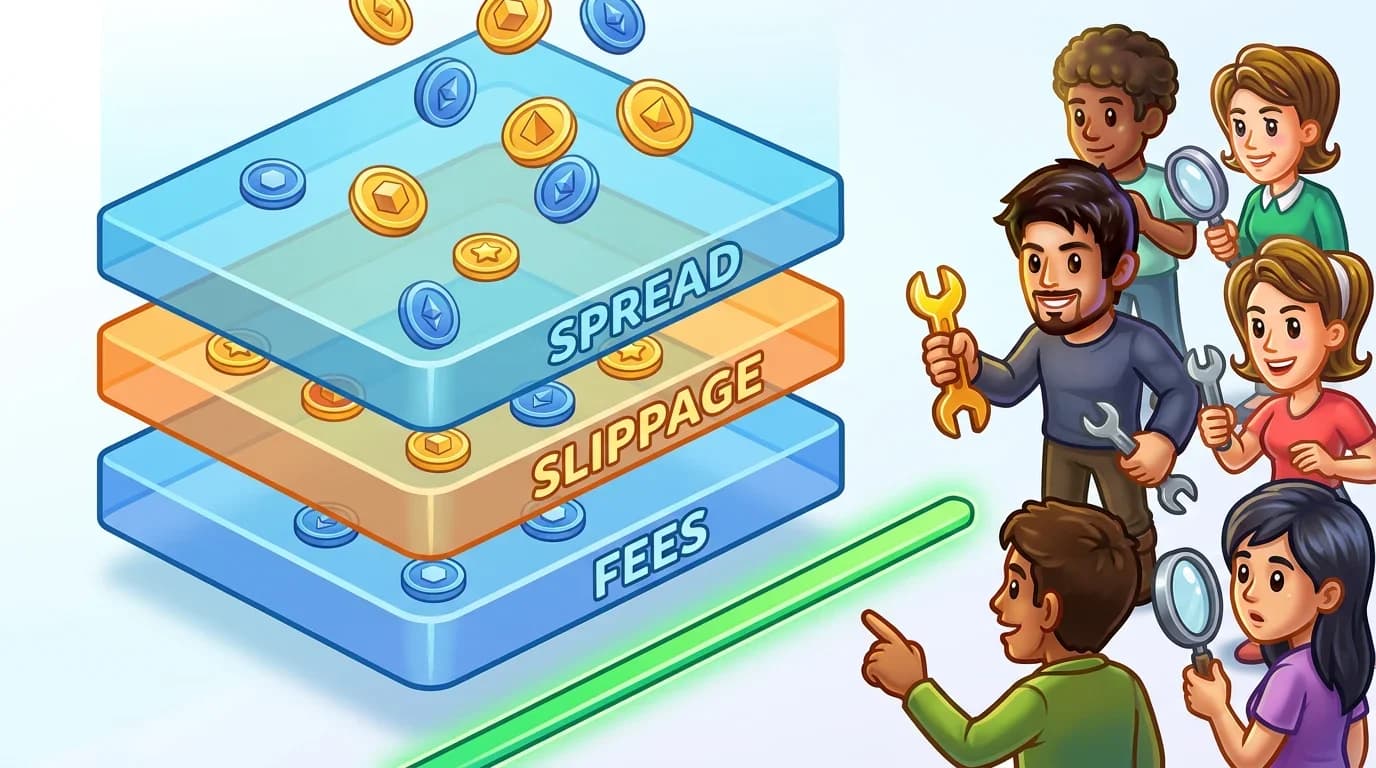
Together, these determine whether a 55-cent entry is actually a 57-cent entry in disguise. These hidden costs also explain why apparent price gaps between platforms often vanish once execution risk is priced in — a reality covered in detail when evaluating arbitrage friction across venues.
If you want to understand how prediction markets work at a structural level, start there. This article focuses on the market microstructure prediction markets use to match buyers and sellers, and how that microstructure eats into your edge after you have picked a direction.
How Spreads Work in Prediction Markets
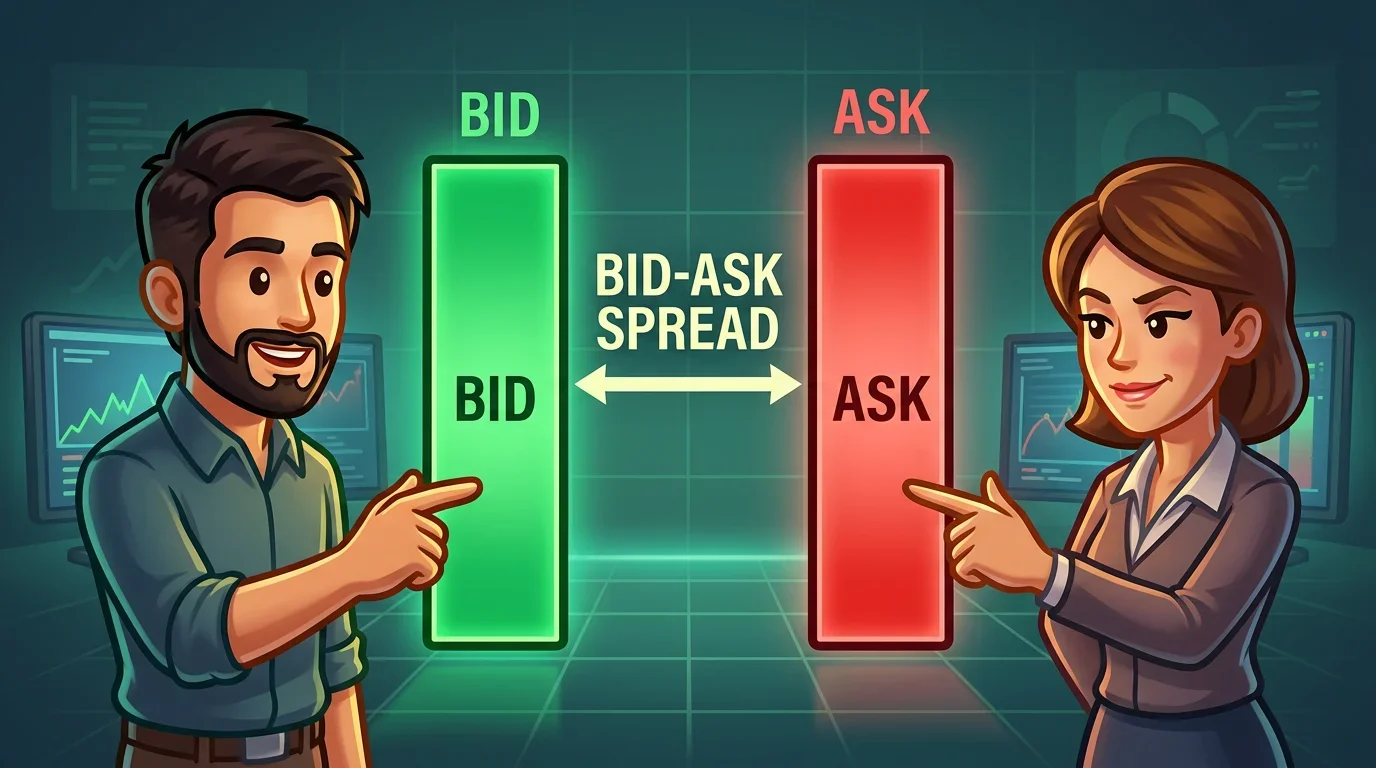
Every prediction market contract shows two prices: the highest price someone is willing to pay (bid) and the lowest price someone will accept (ask). The gap between them is the bid-ask spread, and it is the first price you pay the moment you enter a position.
On a heavily traded election contract, you might see a bid of 0.52 and an ask of 0.53. That one-cent spread is tight. On a niche weather contract, you might see 0.40 bid and 0.60 ask. That twenty-cent spread is a 50% round-trip tax.
What Drives the Spread
The spread is not random. It is built from three layers:
- Fees. Platforms charge to match orders. Market makers embed that cost into the quote.
- Market-maker markup. Anyone providing continuous two-sided prices demands compensation for inventory risk.
- Risk buffer. Uncertain resolution rules or volatile information widen the buffer because the maker fears adverse selection.
How Wide Is Too Wide for a Bid-Ask Spread?
A useful rule: if the spread is wider than the platform fee plus your expected edge, you are paying more for access than the trade is worth. On a yes/no contract priced near 50 cents, a spread above three cents starts to erode returns for short-term holders. Above five cents, you need a strong conviction that the market is mispriced — and even then, implied probability may already reflect the illiquidity premium, not a true edge.
Reading Order Books on Polymarket and Kalshi
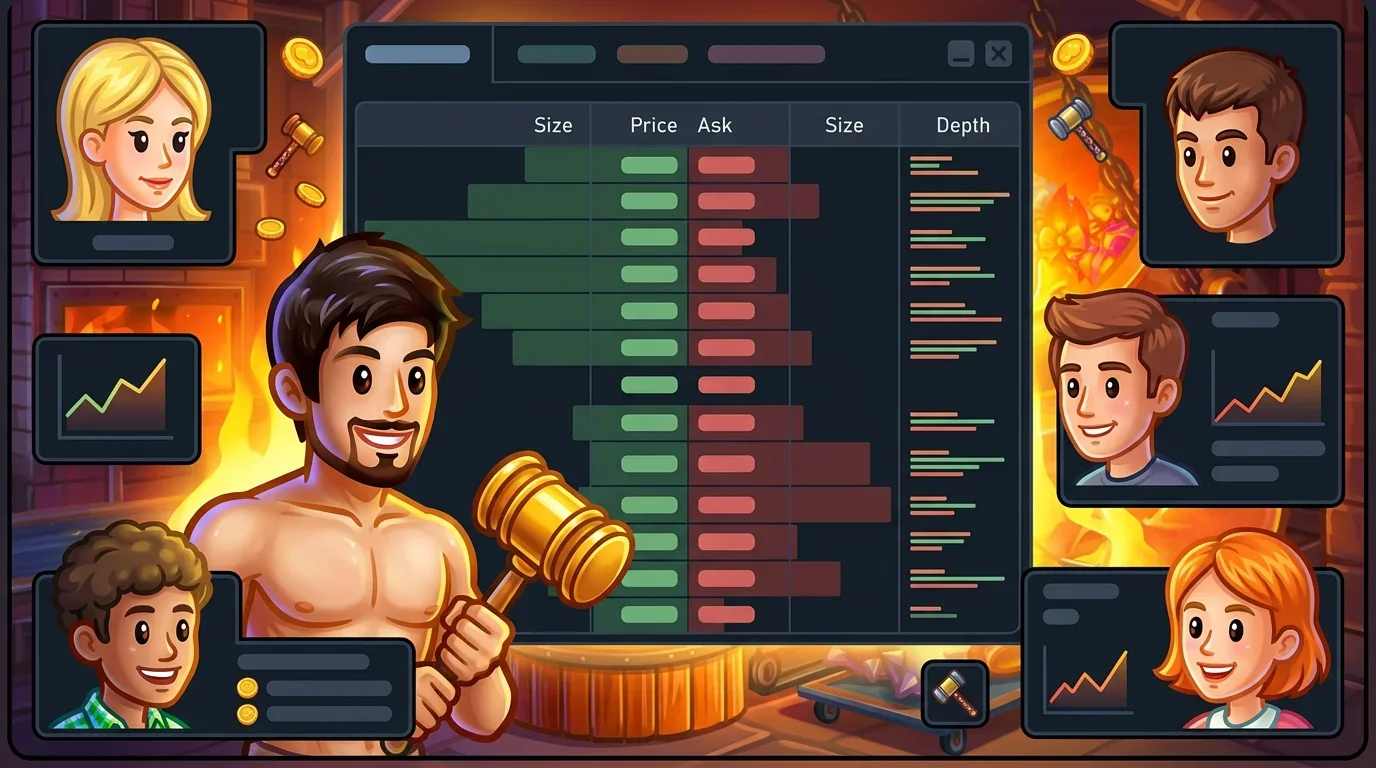
The order book is the real-time ledger of outstanding bids and asks. On Polymarket and Kalshi, it tells you not just where the market is, but how much volume rests at each price level.
How to Read a Prediction Market Order Book
Here is how the interface typically layers information:
On Kalshi, the centralized limit order book displays this stack directly. On Polymarket, the order book is visible through the interface, though some pools use an AMM backend. Either way, the principle is identical: do not look only at the midpoint. Look at the thickness of the stack around it.
Order Book Depth in Prediction Markets vs Displayed Volume
Displayed volume — the rolling 24-hour trade count — does not guarantee depth. A contract can print 50,000 shares in tiny lots and still have only 500 shares resting at the best ask. That is a thin market dressed as a busy one. Always check the depth at two to three price levels above and below your intended entry.
Market Depth Charts and What They Actually Tell You
Depth charts visualize the cumulative orders at each price. They are the fastest way to spot where a large order will hit resistance — or fall through empty air.
When the depth chart shows a steep wall on both sides of the mid-price, the contract has absorptive capacity. When the slope is flat and the stack is concentrated at one level, you are looking at a thin prediction market. In thin prediction markets, a modestly sized order can push the execution price multiple cents away from the quote. That visual flat spot is slippage warning you in advance.

Understanding market depth charts means reading the shape, not just the numbers. A tall bar at 0.50 with nothing behind it at 0.51 or 0.52 tells you that anyone buying more than that bar's size will pay escalating prices.
Slippage in Prediction Markets: The Execution Tax
What Is Slippage in Prediction Markets?
Slippage is the difference between the price you expected when you clicked and the price you actually received after the order filled.
If the best ask is $0.55 with 1,000 shares available, and you buy 3,000 shares, the first 1,000 fill at $0.55. The next 1,000 fill at $0.56, and the final 1,000 at $0.57. Your average fill is $0.56, a full cent above the quoted ask. That one-cent drift is slippage.

Can You Lose Money on Slippage in Prediction Markets?
Slippage is not a loss in the accounting sense — you still own the shares. But it is an immediate cost that raises your breakeven price. On contracts with razor-thin margins, slippage can flip a seemingly positive edge into a negative expected return. Avoiding slippage in prediction markets requires one simple discipline: size your order against the visible depth, not your total intended position. If the depth cannot absorb you, break the trade into smaller lots or use limit orders when the platform supports them.
AMM vs Order Book Prediction Markets
Prediction markets use two matching models: automated market makers (AMMs) and central limit order books (CLOBs). Each surfaces liquidity differently and changes how you think about entering and exiting prediction market positions.
AMMs — used by some decentralized liquidity pools prediction markets rely on — quote prices algorithmically based on a bonding curve. The pool always trades, but the price moves predictably as you buy. There is no visible depth chart in the traditional sense; slippage is baked into the formula.
CLOBs — like Kalshi's native book and Polymarket's order layers — show explicit resting orders. You see exactly where the next seller is. This transparency helps you estimate true cost before sending an order, though market vs limit orders behave differently depending on the venue.

The practical difference: on an AMM, prediction market liquidity pools rely on pool size. On a CLOB, liquidity is a social function of who is willing to post capital. When those posters leave, the book goes thin. When the pool is small, the curve goes steep. Both punish large orders.
How to Check Prediction Market Liquidity Before You Trade
You do not need advanced tools to measure prediction market liquidity. You need a checklist.
Here is the sequence:
- Check the spread width. Measure the gap between best bid and best ask. If it exceeds 2-3% of the contract price, flag it as expensive.
- Check depth at 2-3 price levels. On the order book, look past the best quote. Is there volume one tick away, or is the book hollow?
- Check recent trade size. Look at the last ten prints. Were they 100-share lots or 10,000-share blocks? Small prints suggest institutional avoidance.
- Check time since last print. If the last trade was an hour ago, the quotes may be stale. Spreads can widen with no warning.
- Compare displayed volume to resting depth. High 24-hour volume with thin resting orders means liquidity was fleeting, not persistent.

On Sides, you can pull up live market depth and check the spread before confirming your order inside Telegram, so these steps translate to your next trade in real time.
Why Niche Contracts Have Wide Spreads (And When to Avoid Them)
Why do prediction markets have wide spreads on some contracts and tight spreads on others? The answer is open interest, information flow, and resolution risk.
Liquidity in niche prediction market contracts suffers because:
- Low open interest. Few traders means few natural counterparties. Market makers demand a wider markup to absorb the inventory.
- Single-event risk. A specific rainfall bet or local election resolves once and never repeats. You cannot hedge it across a portfolio.
- Wide resolution variance. When the oracle source or settlement rule is ambiguous, makers widen the buffer to cover the tail risk.

What happens when a prediction market has low liquidity? You enter at 0.60, the event moves in your favor, and the price shifts to 0.75 — but the best bid is 0.65. You are right on the outcome and still underwater on exit. That is the liquidity trap.
If you cannot find acceptable depth on both sides of the trade, the contract is uninvestable at your size, no matter how strong your thesis.
Calculating Your True Transaction Cost
Quoted price is fiction until you account for spread, slippage, and fees. Here is a worked example on a contract quoted near $0.50.

Your true transaction cost for a prediction market position is roughly 3.5 cents round-trip on a fifty-cent contract. Before you take the trade, ask whether your edge covers that friction. If it does not, the market has priced you out before the event begins.
For a deeper look at how to protect your capital after accounting for these frictions, review position sizing and capital allocation strategies.
FAQs
Liquidity varies sharply by contract. Major political and macro contracts on Polymarket and Kalshi can be highly liquid with tight spreads. Niche or thinly traded contracts often behave like thin prediction markets with wide spreads and sporadic execution.
Depth determines how much you can trade before moving the price. Deep books absorb large orders with minimal slippage. Shallow books mean that even modest size pushes the execution price away from the quote, raising your true transaction cost.
You face wide spreads, stale quotes, and difficulty exiting at fair value. A position can show a paper gain while the actual bid is far below the last traded price, trapping your capital until a counterparty appears.
The spread is the gap between the highest bid and lowest ask. It represents the immediate cost of trading and compensates market makers for fees, inventory risk, and adverse selection.
Slippage raises your effective entry price or lowers your exit price. It can erode expected returns and turn a theoretically profitable trade into a loss after accounting for total friction.
Wide spreads appear when open interest is low, resolution uncertainty is high, or the event is niche and hard to hedge. Market makers widen quotes to protect against being picked off by better-informed traders.
Slippage is the difference between the expected fill price and the actual average fill price. It occurs when your order size exceeds the available depth at the best quote.
Check spread width, depth at multiple price levels, recent trade size and frequency, and whether displayed volume matches resting orders. Cross-reference these before committing capital.