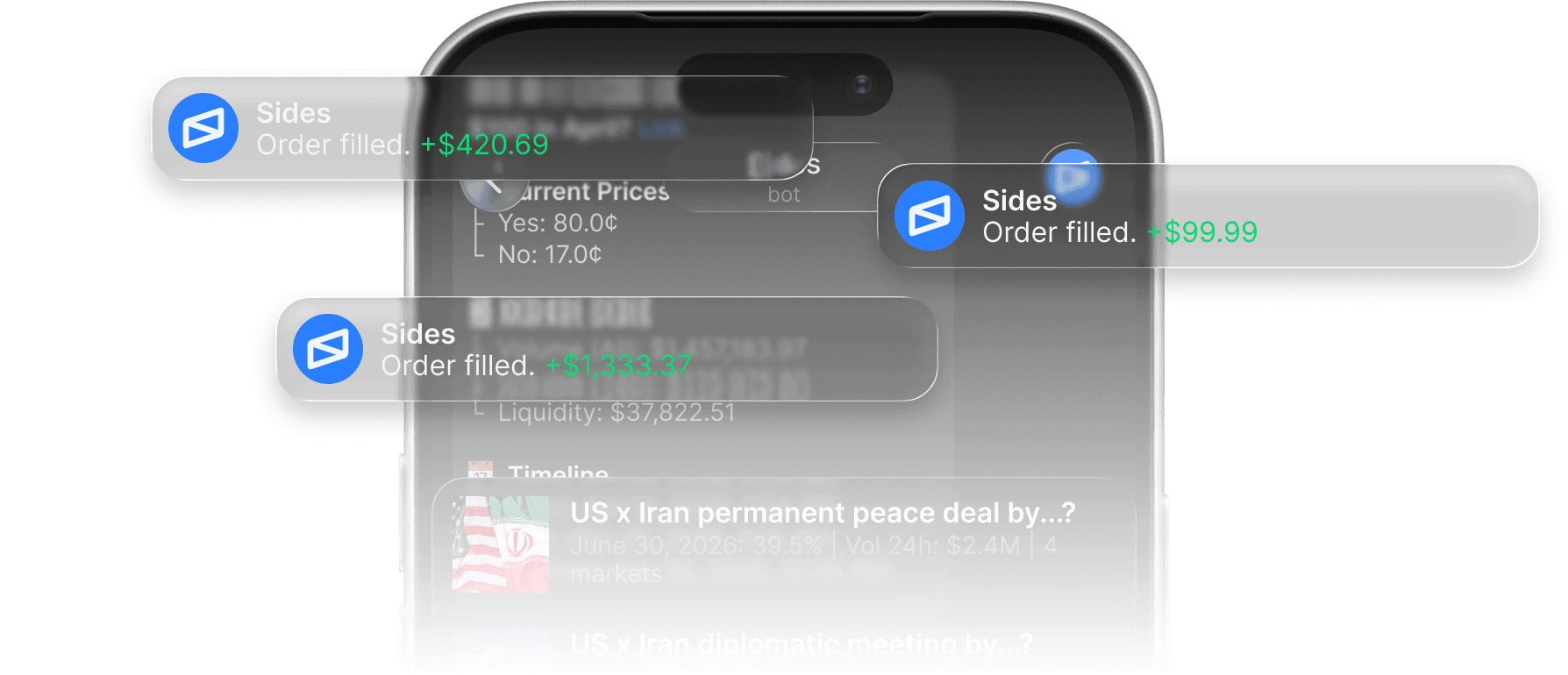
Learn how decentralized betting works in prediction markets: read prices, place orders, manage risk, and trade with Sides inside Telegram.
- Sides Team
- /May 18, 2026
- /16 min read
Decentralized betting sounds simple until you actually open a market.
At first glance, it looks like regular betting with crypto rails. Pick an outcome, place a position, wait for the result. But in prediction markets, the flow is different. You are not only choosing what you think will happen. You are trading a price that changes as information, liquidity, and market sentiment shift.
That small difference changes everything.
A user can enter before the event ends, exit before final resolution, take profit after a price move, reduce exposure when new information appears, or wait until settlement. This makes decentralized betting feel less like a one-time bet and more like trading around outcomes.
This guide focuses on the practical side: how to read a market, how to think before entering, how market and limit orders differ, how to use Sides, what risks matter, and when it is better not to trade.
Quick answer: how does decentralized betting work?
Decentralized betting works through crypto-native or blockchain-based prediction markets where users trade positions tied to future outcomes. Instead of accepting fixed odds from a bookmaker, users buy or sell outcome-based positions at market prices.
A market has a question. Each answer is an outcome. The price of that outcome moves as traders react to news, data, sentiment, and liquidity. If the market moves in your favor, you may be able to exit before the event resolves. If you hold until the end, the result depends on the market's settlement rules.
The practical idea is simple: you are not only asking "Will this happen?" You are asking "Is the current price good enough for the risk I am taking?"
The deeper concept behind this structure is covered in what a prediction market actually represents. This guide focuses on what the user actually does before, during, and after a trade.
Decentralized betting vs traditional betting
Traditional betting is usually built around a bookmaker. The sportsbook offers odds, the user accepts the line, and the position settles after the event.
Prediction markets are more dynamic. Users trade against market participants, not only against a house-controlled pricing system. Prices can move before the final result, so the user may manage the position instead of waiting passively.
In traditional betting, a bookmaker sets fixed odds and the user accepts the line. The user role is passive bettor. Exiting before the result is often limited. The key skill is picking the outcome, and the main risks are a wrong outcome and bookmaker margin.
In decentralized betting and prediction markets, prices move through market activity. The user acts as an outcome trader. Exiting before the result is often possible if liquidity exists. The key skills are pricing probability, timing, and risk control. The main risks are bad price, poor liquidity, weak execution, and resolution risk.
This means prediction markets should not be treated like a regular bet with a different interface. A user can be right about the final result and still make a bad trade if they enter at a poor price.
For a deeper breakdown of the structural difference, prediction markets vs sports betting covers the broader comparison. Here, the main point is practical: prediction market users need to think like traders, not passive bettors.

Before you trade: understand the market in 60 seconds
You do not need to become a market structure expert before placing your first trade. But you do need to understand a few basics before risking funds.
Every market starts with a question. For example:
- Will BTC close above a certain price by a specific date?
- Will a candidate win an election?
- Will a team win a match?
- Will a company launch a product this year?
- Will a macro indicator hit a specific level?
That question creates tradable outcomes. In a simple Yes/No market, the user can take a position on either side. In a multi-outcome market, there may be several possible results.
The position itself is usually structured as an outcome-based contract. The full concept is explained in event contracts in trading, but the practical takeaway is enough for now: you are trading exposure to a defined result, not just expressing an opinion.
The most important thing before entering is wording. Market title, deadline, source, time zone, resolution criteria, and edge cases can change everything. If you only read the headline, you can easily trade the wrong thing.
How to read a market before entering
A good trade starts before the order button.
The first step is reading the market question slowly. Look for the exact condition. Does the market ask whether something will happen at any point, or whether it will happen by a specific deadline? Does it depend on an official source? Does it use closing price, intraday price, announcement date, final vote, or another condition?
Next, check the current price. In many prediction markets, price can be treated as a rough implied probability. If an outcome trades near 60%, the market is roughly saying that participants price the event around 60%.
That does not mean the event is guaranteed. It also does not mean the market is perfectly efficient. Price can be affected by liquidity, spread, hype, slow information, or trader bias.
If you are coming from a betting interface, price and odds may feel like different languages for the same problem: probability and payout. The full breakdown sits in how betting odds work, while this guide focuses on how to use price before placing a trade.
The practical question is:
Do I have a reason to believe this outcome is underpriced or overpriced?
If the market says 40%, and your research suggests the real probability is closer to 55%, there may be a reason to investigate. If the market says 90%, and you also think the event is likely, the trade may still be unattractive because the price already reflects that belief.
That is the difference between having an opinion and having a trade.

How a Prediction Market Trade Works Step by Step
Step 1. Choose a market
Start with a market you actually understand.
A crypto trader may understand BTC price markets better than election markets. A politics follower may read election probabilities better than sports outcomes. A macro-focused user may prefer inflation, rate cuts, or economic data markets.
The goal is not to trade everything. The goal is to find markets where you can judge information better than the average participant.
Step 2. Read the rules
Before looking at price, read the market wording.
Check:
- event condition;
- deadline;
- resolution source;
- time zone;
- edge cases;
- whether the market uses final result, closing price, announcement, or another trigger.
Most beginner mistakes happen here. The user trades the topic they think the market represents, not the actual contract.
Step 3. Compare price with your own estimate
A trade only makes sense if you can compare the market price with your view.
Example:
The market prices "Yes" at 38%. After checking the data, you believe the real chance is closer to 50%. That gap may be interesting.
But if the market prices "Yes" at 78%, and you think the true chance is 75%, then the outcome may happen, but the trade is not attractive.
Being right is not enough. You need the price to be wrong.
Step 4. Decide position size
A strong view does not justify reckless sizing.
Prediction markets can move quickly. New information can appear. Liquidity can disappear. A resolution detail can change the entire setup.
Position size should match uncertainty. If being wrong would damage your ability to keep trading, the size is too large.
Step 5. Choose market or limit order
Order type matters.
A market order prioritizes speed. A limit order prioritizes price. Neither is always better. The right choice depends on urgency, liquidity, and your plan.
This becomes especially important in fast-moving markets. If news just broke, speed may matter. If the market is thin or emotional, price control may matter more.
Step 6. Monitor the position
A prediction market trade does not have to be held until resolution.
If the market reprices in your favor, you may exit early. If new information weakens your thesis, you may reduce exposure. If the price moves too far from fair value, holding may no longer make sense.
This is why prediction markets are more active than simple bets. The trade can change before the event ends.
Step 7. Exit or hold until resolution
At the end, you choose whether to close before settlement or hold until final result.
Holding may make sense when your thesis depends on the final outcome. Exiting early may make sense when the market already moved enough and the remaining risk is no longer worth it.
A good trader thinks about exit before entering.

Market orders vs limit orders
Market orders and limit orders serve different purposes.
A market order is useful when speed matters. You accept the current available price and enter quickly. This can make sense when fresh information hits and you believe the market has not fully reacted yet.
The risk is execution. In a thin market, a market order can fill worse than expected. You may think you are entering at one price and end up with a weaker average.
A limit order gives more control. You set the price you are willing to pay or accept. If the market reaches that level, the order may fill. If not, you stay out.
The tradeoff is patience. A limit order can miss the move completely.
When fresh news breaks and speed matters more than perfect entry, a market order is usually the better choice. In thin liquidity, a limit order helps avoid bad fills. If you have a specific target price, a limit order keeps discipline. For small urgent trades, a market order is simpler and faster. If you are unsure about execution, a limit order reduces emotional overpaying.
For beginners, limit orders are often a better training tool. They force users to decide what price is actually worth paying.

How to use Sides for Prediction Market trading
Sides is built for users who want prediction market access inside Telegram. Instead of jumping between platforms, tabs, wallets, and dashboards, users can open markets, place orders, and manage positions from chat.
That matters because prediction markets move with information. News often appears first in social feeds, Telegram groups, Discord servers, or live discussions. The longer the path from seeing information to acting on it, the more likely the market has already moved.
A practical Sides flow can look like this:
- Open Sides in Telegram.
2. Search for a market or open one from discovery.
3. Read the market question and outcomes.
4. Check the current price.
5. Compare that price with your own estimate.
6. Choose market order if speed matters.
7. Choose limit order if price control matters.
8. Place the trade.
9. Track the position in chat.
10. Exit before resolution or hold until settlement.
Sides is most useful when the user already has a reason to trade. It helps reduce friction between market discovery and execution. It does not replace analysis.
The tool can help you act faster, but it cannot tell you whether the price is fair. That decision still belongs to the trader.

How to manage a position after entry
Opening a position is only the first part. Managing it is where many users fail.
After entering, watch how the price moves relative to your thesis. If the price moves in your favor, ask whether the remaining upside is still worth the risk. Sometimes the best trade is closing early after the market reprices.
If the price moves against you, ask why. Did new information appear? Did liquidity change? Was your original view weak? Or is the market simply moving emotionally?
Do not average down automatically. A lower price does not always mean better value. It may mean the market knows something you missed.
A basic position management plan should answer:
- What price would make me take profit?
- What information would make me exit?
- Am I holding until resolution or trading the repricing?
- How much can I lose if I am wrong?
- Is liquidity still good enough to exit?
Prediction market trading becomes much cleaner when the exit logic exists before emotions arrive.

Beginner framework: before you place a trade
Use this simple checklist before entering any market.
1. Do I understand the exact question?
If the answer is no, do not trade.
You should know what needs to happen, when it needs to happen, and how the result will be judged.
2. Do I understand the current price?
Translate the price into rough probability. If a position trades around 65%, the market is roughly pricing that outcome near 65%.
For users who think in American odds, how to read moneyline odds can help translate betting-style numbers into probability logic.
3. Do I have a real reason to Disagree with the market?
Not vibes. Not "I saw a tweet." Not "everyone is talking about it."
You need a reason: fresher information, better interpretation, different probability estimate, or a view that the market has not fully priced.
4. Is liquidity good enough?
If liquidity is weak, your entry and exit may be worse than expected.
Low liquidity can turn a good idea into a bad trade.
5. Which order type fits the situation?
Use market orders when speed is the priority. Use limit orders when price discipline matters more.
If you are unsure, a limit order is often safer.
6. What is my exit plan?
Decide whether you are trading a short-term price move or holding until final resolution.
Those are different trades.
7. What can go wrong?
Think about:
- bad timing;
- unclear wording;
- low liquidity;
- stale information;
- sudden news;
- poor execution;
- emotional sizing;
- resolution edge cases.
A trade should survive basic questions before money enters.
Example: trading a BTC Prediction Market with Sides
Imagine a market asks whether BTC will close above a certain price by a specific date.
You open Sides in Telegram and find the market. The first move is not buying. The first move is reading the condition. Does it use daily close? Which date? Which time zone? Which source?
Then you check the price. Suppose "Yes" trades around 44%. That means the market roughly prices the outcome below even odds.
Now you compare that with your view. Maybe you think the real chance is closer to 55% because of ETF flows, macro data, funding rates, technical levels, or upcoming market catalysts.
At this point, you have a possible reason to trade. Not because you "like BTC," but because your estimated probability differs from market price.
If you want a specific entry, you place a limit order. If the market is moving quickly and you care more about speed, you use a market order.
After entering, you track the position in Telegram. If the price moves from 44% to 60%, you may take profit before resolution. If new information weakens your thesis, you may exit or reduce size.
The trade is not "BTC up or down." It is:
- what exactly must happen?
- what price am I paying?
- why do I disagree with the market?
- can I exit?
- what changes my mind?
That is the difference between guessing and trading.
How decentralized betting connects to Copy Trading
Decentralized betting and copy trading are different, but they share one user behavior: people follow signals.
In copy trading, the signal may be a wallet, trader, strategy, or leaderboard. In prediction markets, the signal may be price movement, volume, trader activity, odds changes, or reaction to new information.
The broader shift from closed trader profiles to visible trading behavior also appears in decentralized copy trading, where users analyze wallets, strategies, and on-chain activity instead of relying only on platform dashboards.
The same warning applies here. Following a signal is not enough. You still need to understand the market, price, liquidity, and risk.
Common mistakes in decentralized betting
Treating price like certainty
A 70% price does not mean guaranteed outcome. It means the market currently leans that way. The remaining 30% still matters.
Reading only the headline
The title can be misleading if you ignore resolution rules. A market about "touching" a price is not the same as a market about "closing above" a price.
Buying after the move already happened
A user may see news, rush into the market, and enter after the price has already adjusted.
Correct information can still become a bad trade if the entry is late.
Using market orders in thin markets
Market orders are convenient, but weak liquidity can create bad fills.
If the market is thin, a limit order may protect you from overpaying.
Confusing betting confidence with trading edge
Feeling confident is not the same as having edge.
A trade needs price mismatch, not just conviction.
Ignoring position size
Even a strong thesis can fail. Size should reflect uncertainty.
A position that is too large turns a normal loss into a serious problem.
Forgetting that rules matter
Resolution criteria are not optional reading. They decide settlement.
If you do not understand how the market resolves, you do not understand the trade.

When you should not enter a market
Sometimes the best trade is no trade.
Do not enter if the market wording is unclear. If you cannot explain the condition in one sentence, pause.
Do not enter if the market already moved and your only reason is FOMO. Late entries often pay for someone else's early trade.
Do not enter if liquidity is too thin for your size. You may get trapped, especially if you need to exit quickly.
Do not enter if you cannot explain why the market price is wrong. "I think this will happen" is not enough.
Do not enter if you are angry, rushing, or trying to win back losses. Prediction markets reward clear thinking, not emotional recovery trades.
Do not enter if you do not know your exit plan. Holding until resolution and trading a short-term repricing are different strategies.
Where Sides helps most
Sides helps most when workflow matters.
Prediction markets often move at the same speed as news. If the user sees information in a chat, feed, or community, switching between several apps can create delay. Sides brings market access into Telegram, where many users already follow conversations.
Market and limit orders help users match the tool to the trade. If speed matters, the user can act quickly. If price discipline matters, the user can set a target.
Position tracking in chat also helps. Prediction market users may hold several active trades. Seeing positions in the same environment where they follow market discussion can make exposure easier to manage.
Sides is also useful for mobile-first users. The less friction between discovery, analysis, execution, and monitoring, the easier it is to stay organized.
But the product does not remove risk. It improves the flow. The user still needs to read the market, judge price, check liquidity, choose the right order type, and manage position size.
A short note on arbitrage, regulation, and bigger strategy
Arbitrage is possible in prediction markets, but it is not the starting point for most users. It deserves separate treatment because fees, liquidity, settlement rules, timing, and capital lockup can change the entire setup.
The full breakdown of arbitrage on prediction markets goes deeper into that logic. For users comparing practical cross-platform setups, how to arbitrage on Polymarket and Kalshi is the more focused follow-up.
Regulation is also important, especially in markets available to US users or tied to specific jurisdictions. This guide is not a legal overview, but prediction market regulation in the US is useful context for understanding access, platform rules, and market structure.
The point is simple: once you move beyond basic trading flow, details start to matter more. Advanced strategies need their own research.
Conclusion: decentralized betting is about process, not guessing
Decentralized betting in prediction markets is not just picking an outcome and waiting.
A user needs to read the market, understand the price, compare it with their own probability estimate, choose the right order type, manage the position, and know when not to enter.
Sides helps by making the trading flow faster and more natural inside Telegram. It reduces the distance between finding a market and acting on it. That can be useful in fast-moving markets where timing matters.
But good execution does not replace good judgment. A better interface helps only when the user understands the trade behind the click.
The practical rule is simple: do not ask only "Will this happen?" Ask "Is this price worth the risk?"
FAQs
Decentralized betting usually refers to outcome-based markets where users take positions through crypto-native or blockchain-based infrastructure instead of relying only on a traditional bookmaker.
Not always, but prediction markets are one of the clearest examples. They let users trade positions tied to event outcomes, with prices changing before final resolution.
A user chooses a market, reads the question, checks the current price, compares that price with their own probability estimate, places an order, manages the position, and either exits before resolution or holds until settlement.
Prices often act like rough implied probabilities. A position priced around 60% suggests the market sees that outcome near 60%, though fees, spreads, liquidity, and market behavior can affect the signal.
In many prediction markets, yes. Users can often sell their position before resolution if there is enough liquidity.
The biggest mistake is trading the headline instead of the actual market. Users should read the wording, deadline, source, and resolution rules before entering.
Beginners should understand both. Market orders prioritize speed. Limit orders give more price control and can help avoid bad fills.
Sides helps users access prediction markets from Telegram, place market and limit orders, track positions, and reduce app-switching friction.
No. Sides is a trading tool. Users still need to understand market price, liquidity, order type, position size, and risk.
Avoid entering when wording is unclear, liquidity is weak, the price already moved, you cannot explain your edge, or you have no exit plan.
Further reading
- What is a Prediction Market?
- How do Prediction Markets work?
- What is an event contract in trading?
- How betting odds work
- How to read moneyline odds
- Odds formats explained
- Prediction Markets vs sports betting
- Prediction Markets vs polls
- Prediction Market Regulation in the US
- Prediction Market arbitrage
- How to arbitrage on Polymarket and Kalshi
- Decentralized Copy Trading explained