A clear explanation of how prediction markets work, how traders take positions, how prices move, and how markets settle after the outcome.
- Sides Team
- /April 01, 2026
- /7 min read
Prediction markets turn uncertainty into something people can trade. Instead of asking a crowd what they think will happen, these markets ask participants to put money behind their view. That simple shift changes the quality of the signal. When people have capital at risk, they usually react faster, update faster, and think more carefully.
Prediction markets attract attention because they do more than describe opinions. They turn expectations about future events into live prices that traders can challenge, update, and trade. They want to know what a prediction market actually is, how the price is formed, why that price often looks like a probability, and whether these markets are useful in the real world.

What Is a Prediction Market?
A simple way to define it
A prediction market is a market where traders buy and sell contracts tied to future events. The event can be political, financial, sports-related, or crypto-native. If the stated outcome happens, the winning contract pays out. If it does not, the contract loses its value or settles close to zero, depending on the structure.
In plain terms, this is a system for trading expectations. You are not buying a company or lending money to an issuer. You are taking a position on whether something will happen by a certain date, and the market price reflects how likely that outcome seems to active traders.
Why it is not the same as ordinary betting
At first glance, prediction markets look a lot like betting. Both involve uncertain outcomes, both involve money, and both reward people who end up on the right side. That is why newcomers often treat them as the same thing.
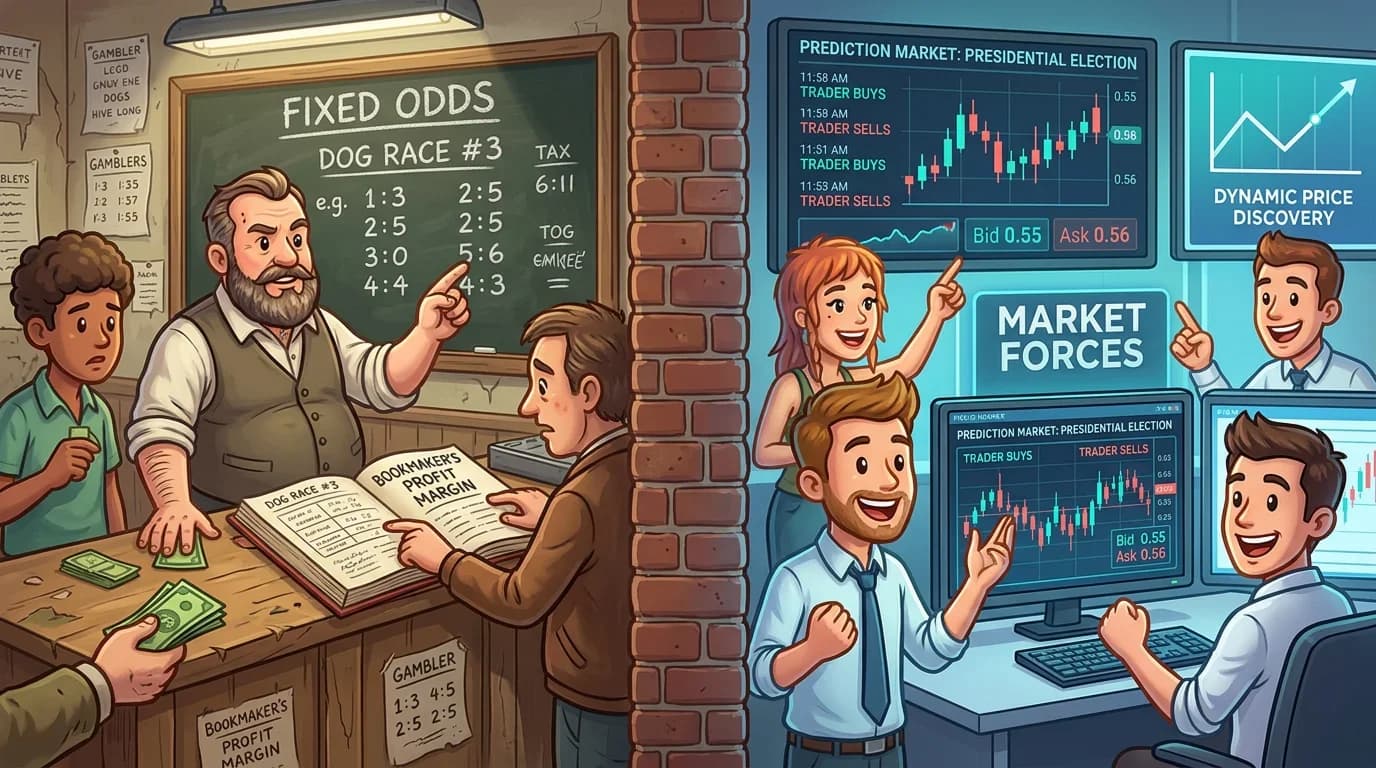
The difference is in the market structure. In traditional betting, odds are often posted by a bookmaker. In prediction markets, prices usually move through trading. Participants can enter early, leave early, react to new information, and treat the price itself as a signal. That makes the experience much closer to a live market than to a one-time wager.
The Basic Flow of a Prediction Market
From a question to a tradable market
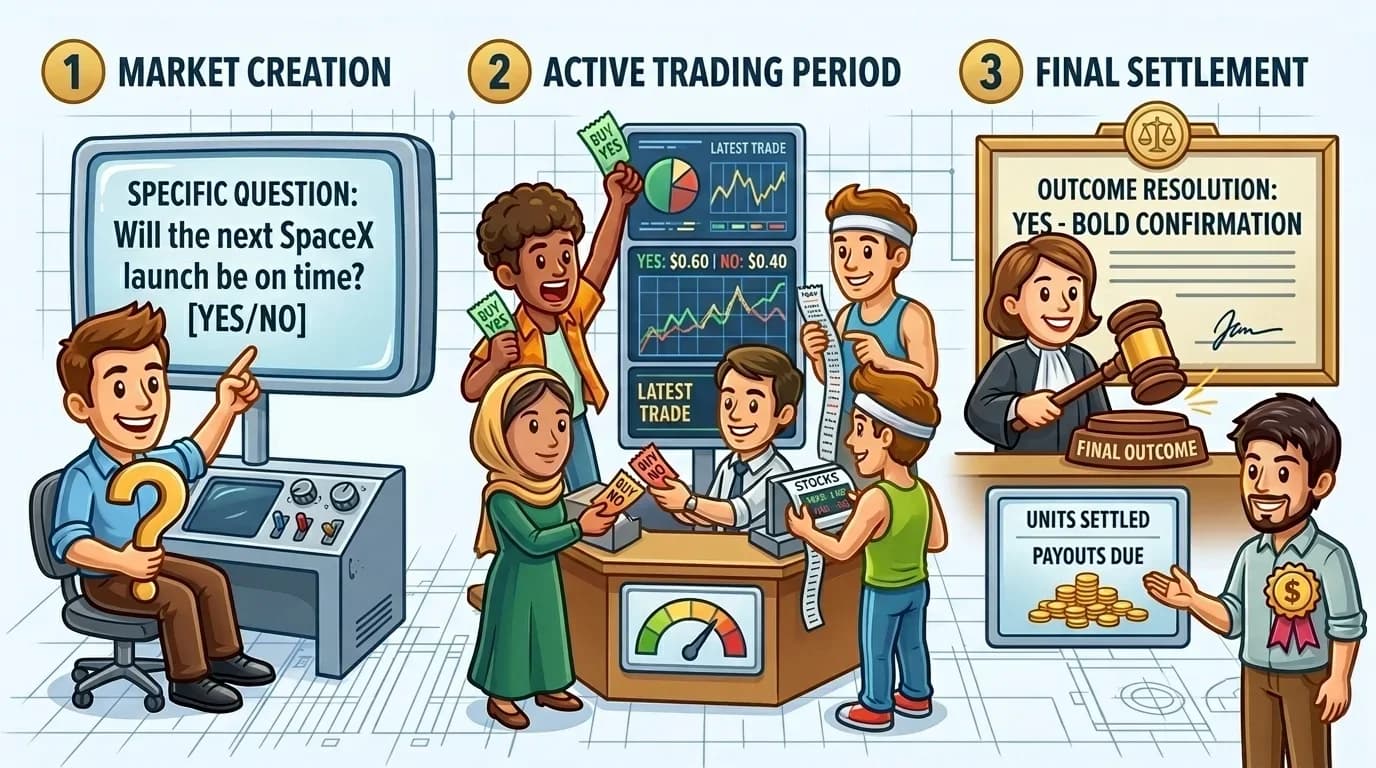
Everything starts with a clearly defined question. It might ask whether a candidate will win an election, whether inflation will exceed a threshold, or whether a certain sports team will take a title. The question has to be specific, time-bound, and easy to resolve later.
This step matters more than many people think. If the wording is vague, the market becomes weak from the start. Traders stop focusing on the event and start arguing about what the question actually means. A strong prediction market begins with a question that leaves very little room for interpretation.
How traders take positions
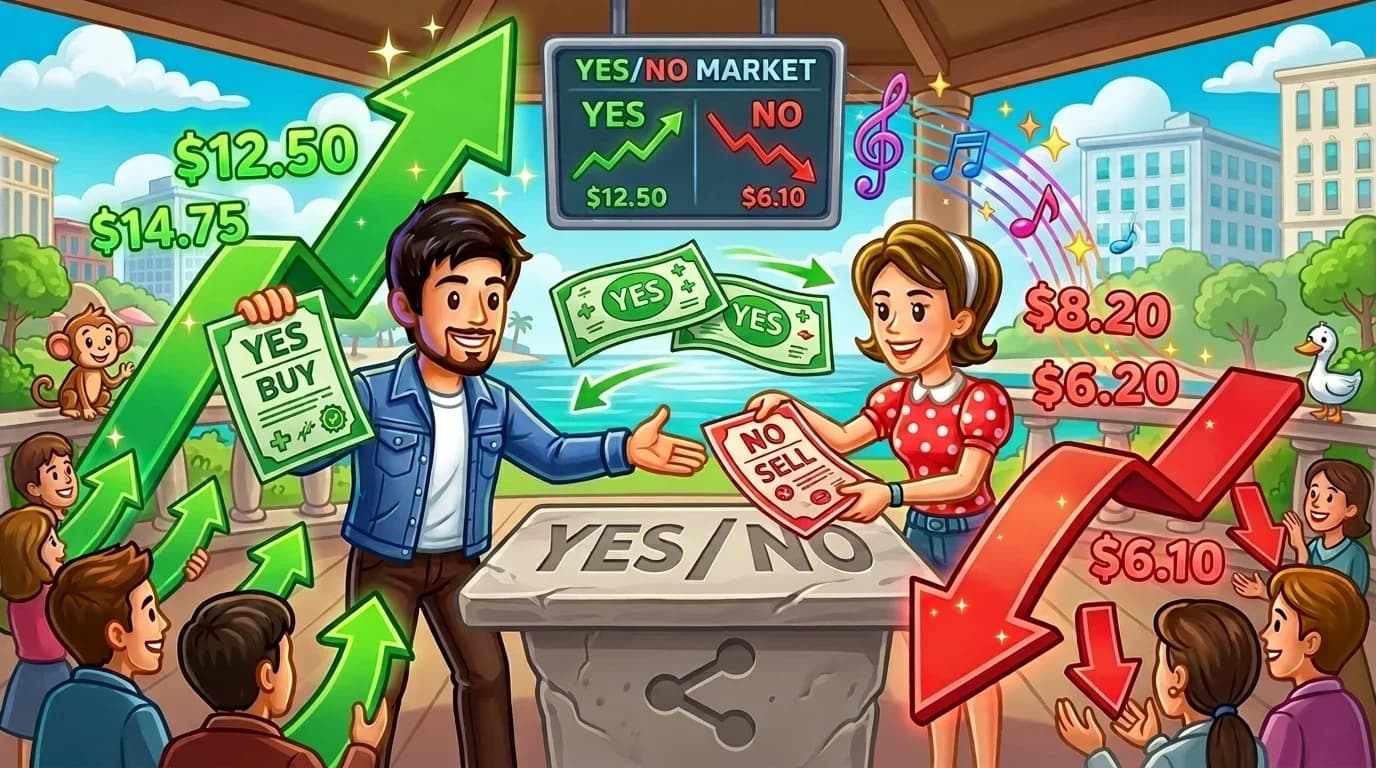
Once the market opens, users can buy and sell shares tied to one or more outcomes. In a simple Yes/No market, someone buys "Yes" if they believe the event is more likely than the current price suggests. If they think the crowd is too optimistic, they may buy "No" or sell the opposite side instead.
These shares are not ownership in anything productive. They are conditional claims. Their value depends entirely on the final result. That is the central mechanic: the market gives each side of an uncertain event a tradeable price, then lets people challenge that price through buying and selling.
What happens when the event is resolved
When the deadline arrives and the outcome becomes known, the market settles. The platform checks the agreed source of truth, such as official election results, a sports league record, or a published economic release. Once the answer is confirmed, the winning side is marked and payouts are processed.
This is also the moment that turns a forecast into an actual financial result. Until settlement, traders are dealing with moving expectations. After settlement, the market stops being a live estimate and becomes a finished contract with winners and losers.
How Pricing Works
Why the number on screen looks like a probability
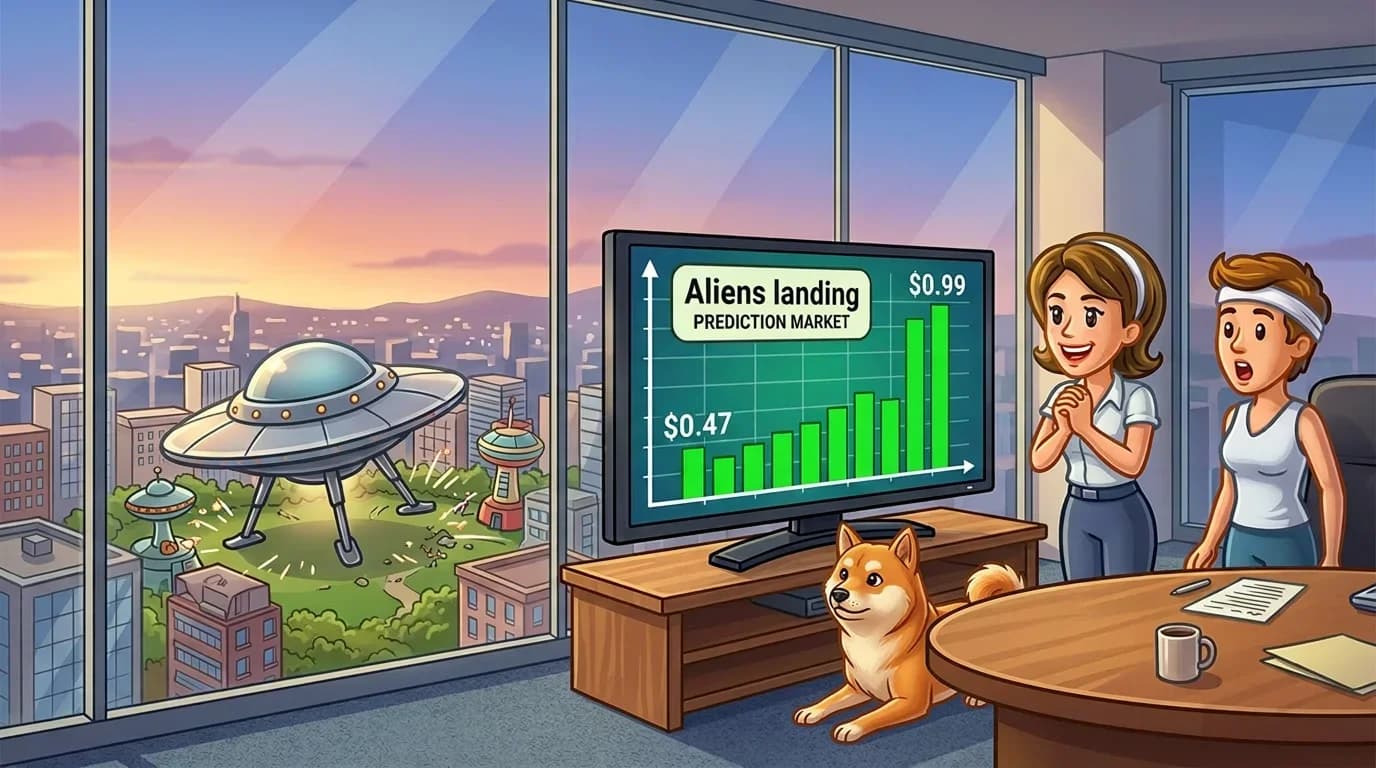
Take an election market. A candidate may begin at 47 cents, meaning the crowd sees the race as fairly close. After a strong debate, favorable polling, or a fundraising surprise, that price may climb to 56 cents. The change does not mean the election is decided. It means expectations shifted.
The same logic works in sports and finance. A championship market can move on injury news or playoff results. A macro contract can reprice after inflation data or central bank commentary. The topic may change, but the mechanism stays the same: new information arrives, traders react, and the market updates the price of each outcome.
One full walk-through from entry to payout
Imagine a market asking whether inflation will finish the year above a specific level. You buy "Yes" at $0.35 because you think the market is underestimating the chance. A month later, hotter data pushes the price to $0.51. At that point, you can sell and lock in a trading gain.
If you decide to hold and the condition is eventually met, the contract settles at full value and you get paid. If the data comes in lower and the condition fails, the position loses. This simple example shows the full cycle clearly: entry, repricing, resolution, payout.

Decentralized Markets and the Oracle Problem
What changes when the market moves onchain
In decentralized prediction markets, smart contracts replace much of the traditional backend. Funds can be held onchain, trades can be recorded publicly, and payouts can be triggered by code instead of by a centralized operator. That makes the system more transparent and easier to audit.
The trade-off is complexity. Users need wallets, may face gas fees, and depend on contract design as well as market design. The basic idea stays the same, but the infrastructure becomes more technical, which adds friction and introduces new forms of risk.
Why outside data still decides everything
A smart contract cannot know by itself who won an election or whether a macro release crossed a threshold. It needs an external input, usually delivered through an oracle. The oracle brings offchain facts into the onchain system so the market can settle.
This is one of the hardest parts of decentralized prediction markets. The trading logic may be excellent, but bad external data can still break settlement. That is why resolution rules and trusted data sources matter so much. The market can only be as clean as the process used to confirm reality.
Main Weaknesses and Limits
Liquidity, manipulation, and legal pressure
Low liquidity is one of the biggest problems in this space. If very few people are trading, prices can swing too much and stop being trustworthy. A market may show a neat number on the screen, but that number can be fragile if one moderate order is enough to move it sharply.
Manipulation and regulation create another layer of risk. Thin markets are easier to distort, and the legal treatment of prediction markets varies by country and by platform design. So even if the idea is strong, the quality of the product still depends on participation, market depth, and a workable legal environment.

Why They Matter Beyond Gambling
Markets as a measure of collective belief
Prediction markets do more than create a place to speculate. They turn belief into price. Instead of asking what people say they think, they show what people are willing to back with money. That difference makes the signal more interesting for analysts, traders, and researchers.
This is why they matter beyond gambling. A good prediction market can function as a live measure of expectation. It tells you how a crowd with real exposure is pricing uncertainty right now. That does not make it infallible, but it does make it more valuable than casual opinion alone.
Conclusion
The clearest short version
Prediction markets take a future event, split it into tradeable outcome shares, let traders buy and sell those shares as expectations change, and then settle the market once reality becomes known. Prices move because beliefs move, and payouts happen because the event eventually becomes measurable.
In short, prediction markets work by turning uncertainty into tradable prices. When traders disagree, buy, sell, and react to new information, the market creates a live estimate of what the crowd currently believes is likely. It works when people challenge each other's expectations through trading, and it becomes useful when that trading turns scattered information into one live signal.
FAQs
They can be very useful when the question is clear, liquidity is strong, and enough informed people are active. Under those conditions, they often react faster than polls or static expert takes. Their strength is not perfection, but constant updating.
They become much less reliable when participation is thin, market wording is weak, or settlement is likely to be disputed. In other words, a prediction market is only as strong as its design, its liquidity, and its resolution process.
Most traders profit in one of two ways. They either buy low and sell higher before the event resolves, or they buy a position and hold it until the final payout. The first path depends more on timing, while the second depends more on correctly calling the event.
That distinction matters because many newcomers assume profit only comes at the very end. In reality, a lot of market activity happens before settlement, when prices are still shifting in response to news and changing expectations.
Onchain systems cannot directly observe real-world outcomes. A smart contract may be able to hold money and execute rules, but it still needs outside data to know whether the event actually happened. That is the oracle's job.
Without a reliable oracle, decentralized prediction markets cannot settle properly. That is why outside data is not a side issue. It is one of the core pieces that decides whether the whole market can be trusted.