Learn what moves prediction market prices. Discover how breaking news, data releases, sentiment shifts, and order flow reprice contracts, plus how to separate signal from noise when markets move.
- Sides Team
- /July 22, 2026
- /8 min read
Prediction market prices change because traders update their beliefs when new information arrives. A headline, data release, viral narrative, or sudden block trade can alter the implied probability of an outcome in seconds. The core prediction market price drivers are breaking news, scheduled events, sentiment shifts, correlated asset moves, and large order flow. Markets reprice the moment fresh information reaches the order book, though not every spike reflects durable value. Understanding what moves prediction market prices helps you time entries without chasing noise, yet even accurate information can be priced in too early, too late, or incorrectly. Every position still carries the possibility of total loss.

A Quick Refresher on Prediction Market Pricing
Before dissecting catalysts, remember what the price itself represents. A binary contract trades between $0.00 and $1.00, with the last price reflecting the crowd’s current estimate of the event occurring. When new information changes that perceived probability, the price shifts to a new equilibrium.

For the mechanics of price formation, settlement, and order matching, see our deep dive on how prediction markets work. If you are newer to the space, start with what is a prediction market.
The Five External Catalysts That Reprice Contracts
If you are trying to predict what causes prediction market prices to change, focus on the external forces that force participants to revise their forecasts. These prediction market catalysts flow into the order book from outside the platform.
Breaking News and Event Shocks
Unscheduled headlines—court rulings, geopolitical incidents, surprise resignations, or regulatory enforcement actions—create the most violent prediction market news impact. When a shock hits, market makers often pull quotes, spreads widen, and aggressive takers slam the book. The result is a sharp repricing that may overshoot before stabilizing. How the market handles the first thirty to sixty seconds after a headline usually reveals whether the move rests on durable facts or panic-driven noise.

Scheduled Data Releases
Not all moves are surprises. Scheduled events like inflation prints, earnings reports, election polling drops, or regulatory rulings let traders prepare positions ahead of time. Ahead of the release, prediction market pricing often compresses as the crowd narrows its expectations. Once the data drops, the contract reprices almost instantly in liquid markets, but the direction depends on the deviation from the consensus already baked into the price. This is how information gets priced into prediction markets: the market holds an implied forecast, and the surprise relative to that forecast drives the post-release drift.

Sentiment Shifts and Social Momentum
Prediction market sentiment can detach from fundamentals during viral moments. A trending narrative on social platforms can attract directional capital from non-experts, pushing a contract away from its fair value. Sentiment-driven moves are fast, reflexive, and sometimes self-reinforcing. The risk is conflating volume with validity. A contract surging on pure momentum may correct sharply once the narrative fades.

Correlated Market Moves
Prediction markets do not trade in isolation. Equity indices, crypto prices, FX rates, and commodity markets can all bleed into event-contract pricing. A crypto-adjacent regulatory market, for instance, may swing as Bitcoin moves even if no new policy has emerged. These correlated flows create proxy hedging and speculative spillovers. When analyzing prediction market price movement explained by external assets, ask whether the contract is repricing on direct news or simply riding a related market’s volatility.

Large Order Flow and Whale Activity
A single large market order or limit sweep can shift the implied probability of a thinly traded contract. In low-liquidity markets, one participant’s conviction trade becomes a temporary price driver. Unlike external news, this catalyst is endogenous to the platform, but it still forces others to react. If a contract jumps without any headline, liquidity dynamics may be the real reason. Our article on how spreads, order books, and slippage shape your trades explains why this matters during volatile repricing.

How Prediction Markets React to News: From Headline to Order Flow
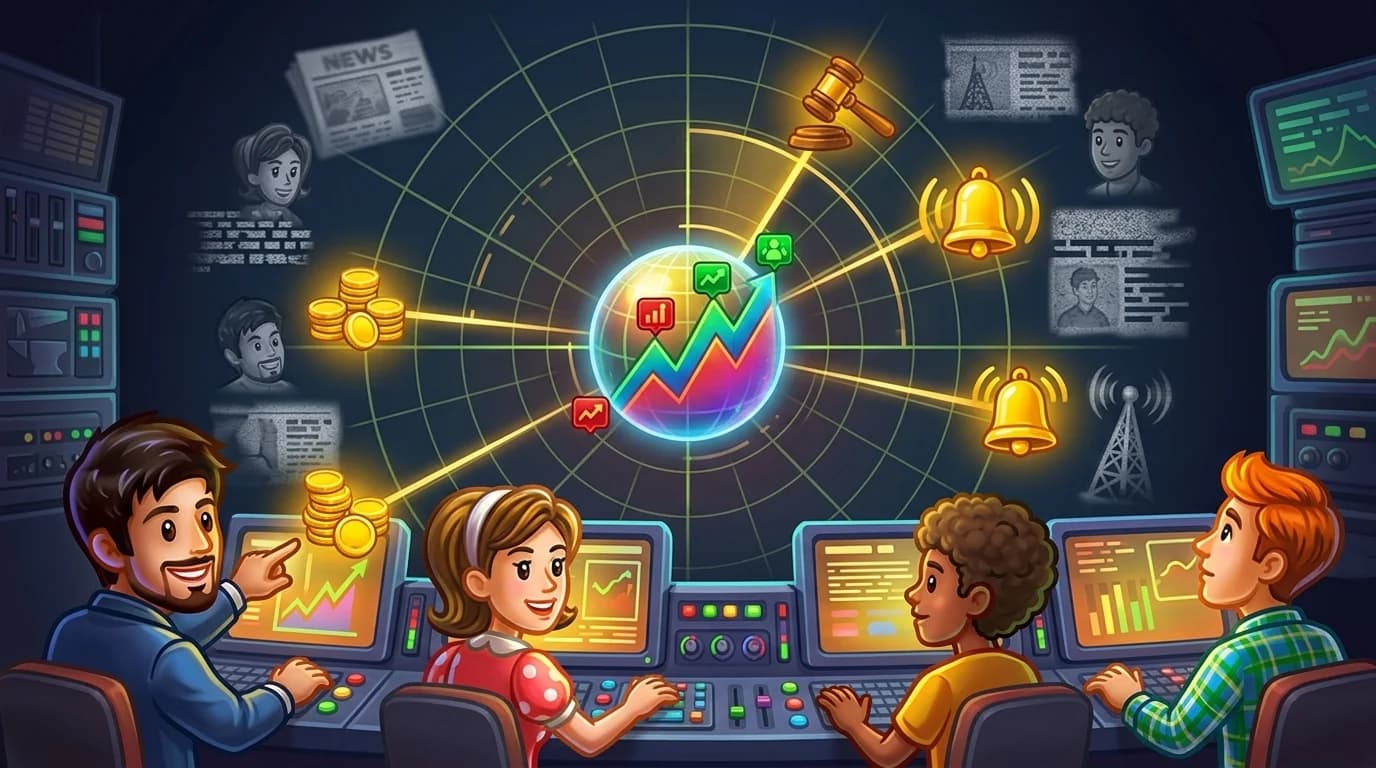
The path from headline to repricing is shorter than many assume, but it is not instant. Here is how prediction markets react to news in practice:
- Information enters the public sphere — a wire story, official filing, or viral post appears.
- Fast participants act first — traders with monitoring feeds or alerts interpret the signal and submit orders.
- The order book absorbs the flow — resting limits are hit and market makers adjust quotes.
- Price discovery spreads across venues — the new level is either validated by follow-through volume or rejected by contrarian flow.

The efficiency of this sequence depends on the platform. Decentralized markets with fragmented liquidity may lag centralized venues by minutes during a shock. That lag is one reason some traders watch multiple platforms at once. If you notice a speed gap, our guide to prediction market arbitrage and the practical steps in how to arbitrage on Polymarket and Kalshi may be useful.
Speed of Price Discovery
How fast do prediction markets price in new information? In highly liquid political or macro contracts on major platforms, the answer is often under a minute for straightforward headlines. Complex or niche markets—science questions, geopolitical micro-events, or low-profile sports props—can take hours or days because fewer participants are watching and capital is scarce.
Efficiency varies by:
- Liquidity depth: Deep books absorb news without whipsawing; thin books gap.
- Participant specialization: Markets with expert-heavy crowds converge faster.
- Resolution clarity: Contracts with binary, verifiable outcomes repricing faster than ambiguously worded ones.

A contract that has not moved yet is not necessarily mispriced; it may simply be illiquid or overlooked. Rushing in assuming you are early can mean you are simply wrong.
Signal vs. Noise: Why Do Prediction Market Prices Change?
Every jump is not a genuine shift in probability. Here is how to separate signal from noise:
- Volume confirmation: A price shift on heavy volume reflects conviction; a thin-air spike often reverses.
- Sustained quotes: If the new level holds for several minutes and market makers rebuild depth around it, the market is digesting information rather than rejecting it.
- Cross-platform consistency: When the same event trades on multiple venues and all reprice in the same direction, the catalyst is likely external and real.
- Source traceability: Can you point to a specific headline or data point? If not, the move may be sentiment-driven noise.
Overreactions are common after emotionally charged news. The market frequently spikes, retraces as contrarians sell the move, and then settles at a middle ground. Entering at the initial extremity usually means buying someone else’s exit.
Real-World Examples of Information-Driven Repricing
While specific contracts change daily, certain patterns repeat across platforms. A political futures market may gap ten cents within seconds of a debate gaffe, then spend the next hour retracing half that move as analysts dispute the significance. A macro inflation market can sit idle for days ahead of a CPI release, then snap to a new level within thirty seconds of the print, leaving late entrants with no edge and wide spreads. A niche technology market may barely move on a mainstream headline because the participant pool is too small to generate meaningful two-sided flow. These examples show why prediction market news impact is as much about market structure as it is about the headline itself.
Practical Timing Principles After an Information Shock
If you trade around prediction market catalysts, consider the following constraints:
- Let the first minute pass: The opening print after a shock is frequently the worst price. Let the book rebalance.
- Check the calendar: Scheduled releases often carry a pre-positioned crowd. The post-number drift may already be half-baked.
- Size for the exit: Even if your read is correct, you need a counterparty when you close. Wide spreads after news can make exiting costly.
- Separate your thesis from the tape: Just because the market disagrees with you does not mean it is wrong. The crowd may be pricing in a second-order effect you missed.
Understanding prediction market price drivers improves decision-making, but it does not remove risk. Markets can price in a development too early, too late, or in the wrong direction relative to your position. All positions carry the possibility of total loss.
Common Trader Mistakes When Reacting to News
- Chasing the initial spike: Buying after a vertical move usually means absorbing the premium created by the first wave.
- Ignoring resolution timelines: A contract with months until settlement can whipsaw on daily headlines that ultimately do not change the outcome.
- Overweighting a single source: One viral thread is not a macro catalyst, even when it feels overwhelming.
- Neglecting fees: Frequent trading around news racks up platform fees and spread costs that erode any edge.
Monitoring Repricing in Real Time
Catching when new information is actively repricing a contract requires watching price, volume, and news simultaneously. Sides.Trade surfaces live price shifts and market updates inside Telegram, giving you a consolidated view of when a contract is moving and what might be driving it. It is a monitoring layer, not a signal service—useful for spotting activity that warrants closer inspection before you decide whether to trade.
FAQs
Prediction market prices move when traders revise the implied probability of an outcome based on new information. The main drivers are breaking news, scheduled data releases, sentiment shifts, correlated asset moves, and large order flow that hits the book.
Markets price in news through a chain of order flow: information appears, fast participants submit orders, the book absorbs the flow, and the last traded price shifts to a new equilibrium. In liquid contracts, this can happen within seconds; in thin markets, it may take hours.
Prices change because the crowd’s aggregate belief about a future event is not static. Every headline, data point, or narrative shift updates trader expectations, and the contract reprices to reflect the new consensus, even if that consensus is later proven wrong.
Odds shift when the balance of buy and sell pressure changes. External catalysts like news or economic data alter that balance by convincing one side to enter or exit. Internal catalysts, like a whale sweep in a thin book, can also force a temporary odds shift without new information.
Highly liquid political and macro contracts often reprice in under a minute after a straightforward headline. Niche or low-liquidity markets can take hours or days because fewer traders are watching and less capital is deployed to close valuation gaps.