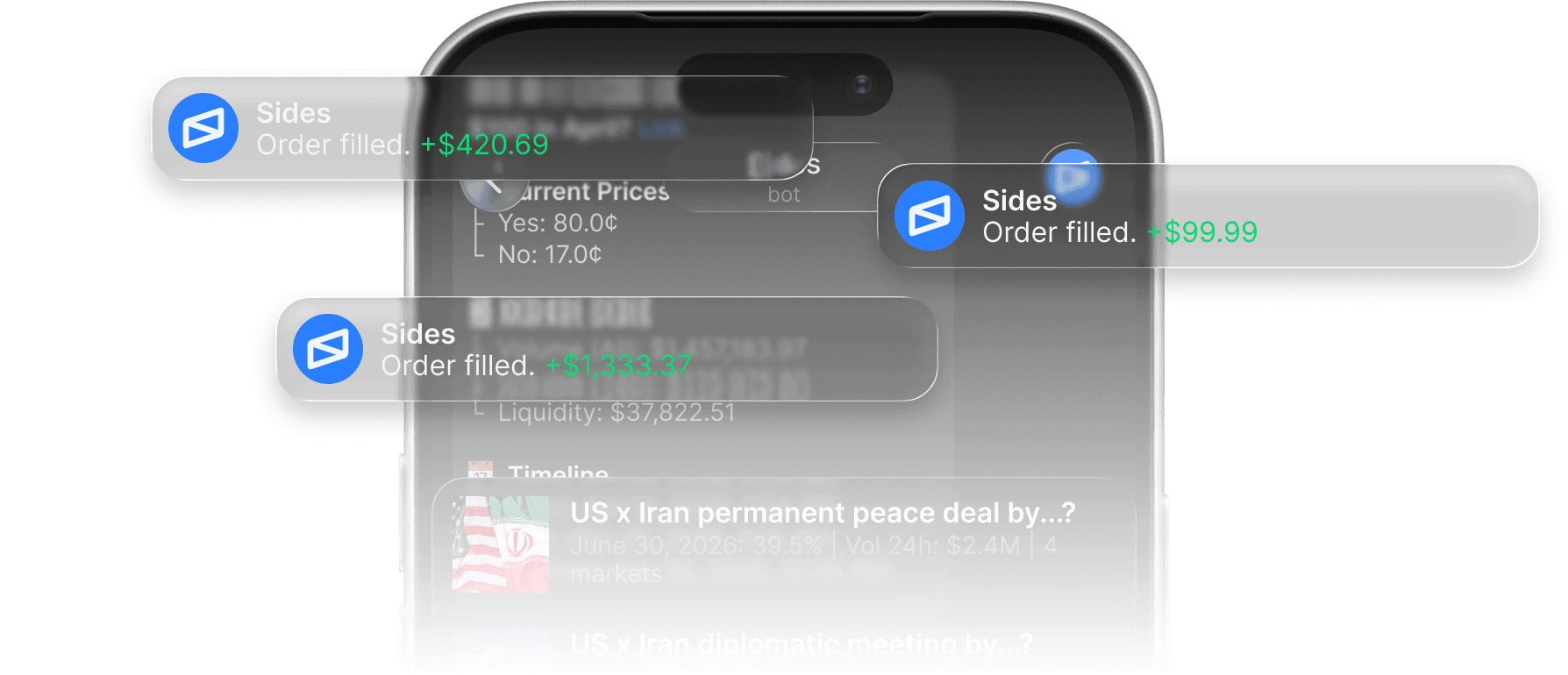
Learn how Polymarket makes money: taker fees by category, maker and taker rebates, fee-free geopolitics markets, and what traders actually pay.
- Sides Team
- /August 06, 2026
- /4 min read
Polymarket makes money primarily by charging protocol taker fees on many fee-enabled markets. Those fees are set at match time, paid in the trading collateral, and partly redistributed as maker and taker rebates—so “platform revenue” is the fee pool minus what goes back to liquidity providers and active takers.
That is different from how you make or lose money trading. Trader PnL comes from buying and selling outcome shares as prediction markets reprice events. Fees are a trading cost on top of that path, not a substitute for edge.
How does Polymarket make money?
The core loop is simple:
- A taker hits resting liquidity on a fee-enabled market.
- The protocol applies a taker fee using a price-sensitive formula.
- A share of collected fees funds maker rebates (daily payouts for filled maker liquidity).
- Active takers can earn taker rebates back by climbing volume tiers.
- Referrers can earn a cut of net fees from referred traders.
- Apps in the Builder Program can attach a builder fee on top of platform fees.
Polymarket’s docs state that geopolitical and world events markets are fee-free—the platform does not charge fees or take trading profit on those markets. Deposit and withdrawal also have no Polymarket fee (bridges and on-ramps may still charge).
Does Polymarket charge trading fees?
Yes—on most categories—only for takers. Makers are not charged protocol fees when their resting liquidity is taken.
Category taker fee rates (from Polymarket’s fee docs):
Rates and rebate percentages can change. Always check the market’s fee parameters before sizing a trade.
How are Polymarket taker fees calculated?
Fees use:
- C = shares traded
- p = share price
- feeRate = category / market parameter
Dollar fees peak near 50¢ (maximum ) and shrink toward the extremes. A 30¢ fill and a 70¢ fill of the same size pay the same USDC/pUSD fee. Fees round to five decimals; tiny extreme-price fills can round to zero.
Example scale (100 shares, crypto rate 0.07): at 50¢ the docs show about $1.75 taker fee on $50 of notional; at 10¢ or 90¢ the fee drops to about $0.63.
How do maker and taker rebates work?
Maker rebates Taker fees fund a daily rebate pool. Makers earn based on the share of executed maker liquidity they provided in each market (fee-curve weighted). Payouts are in pUSD, with a $1 minimum accrual before payout.
Taker rebates Takers climb tiers from Bronze to Obsidian based on 30-day Weighted Volume. Higher tiers return a larger % of fees on future taker trades (up to 50% at Obsidian). Geopolitics earns no weighted volume because it is fee-free.
Referrals Eligible referrers earn a share of net fees (after the referred user’s own tier rebate)—10% direct, 5% indirect—within program caps and time windows.
Builder fees Third-party apps can charge an additive builder fee (capped) when their builder code is on the order. That fee stacks on the platform fee; it does not replace it.
Which Polymarket markets are fee-free?
Official docs: geopolitical and world events markets charge 0 taker fee and do not pay maker rebates. Everything else in the fee table above can collect taker fees unless a specific market’s details say otherwise.
If you are comparing venues, fee schedules and market structure both move prices—Polymarket and Kalshi often diverge for reasons beyond the fee line alone.
How do Polymarket fees change what traders pay?
Treat fees as part of your all-in cost next to spread and slippage. In thin books, liquidity costs can dwarf the protocol fee. Near 50¢, the fee curve is most expensive per share; near the extremes it is cheaper but prices already embed less upside per share via implied probability.
Practical habits:
- Confirm whether the market is fee-enabled before marketable size.
- Prefer maker fills when you want to avoid taker fees (and possibly earn maker rebates).
- Remember builder-routed apps may add a second fee layer.
- Deposit/withdraw: no Polymarket fee, but rails can still cost money.
If you trade from Telegram rather than building fee math into a bot, Sides.Trade keeps markets, orders, and portfolio in one chat—still check the market’s fee settings the same way you would on-web.
What is the difference between Polymarket revenue and trader profits?
Search results mix two questions:
- Platform: How does Polymarket monetize? → taker fees (minus rebates/referral shares), plus ecosystem programs like builders.
- Trader: Can people profit on Polymarket? → yes or no depending on selection, timing, fees, and risk—not a revenue-model answer.
This article answers the platform question. Trader outcomes are separate and never guaranteed.
FAQs
Mainly from protocol taker fees on fee-enabled markets. Part of that fee pool is paid out as maker and taker rebates; geopolitics markets are fee-free.
Yes for takers on most categories. Makers pay 0% protocol fees. Geopolitical and world events markets have no Polymarket trading fees.
Polymarket does not charge deposit or withdrawal fees. Payment processors, bridges, or exchanges may still charge their own fees.
fee = shares × feeRate × price × (1 − price). Fees peak near 50¢ and fall toward 0¢ and 100¢ prices.
No. Protocol fees apply to takers. Makers can earn daily rebates when their resting liquidity is taken on fee-enabled markets.
A daily pUSD payout funded by taker fees, allocated to makers by their share of executed maker liquidity in each market.
Tiered fee kickbacks based on 30-day Weighted Volume. Higher tiers return a larger percentage of fees on future taker trades.
No for most categories. Geopolitics and world events remain fee-free; other categories use the published taker fee schedule.
They can. Builder fees are additive on top of platform fees when an order carries a builder code, within program rate caps.
Use Polymarket’s official Fees and market-details docs for the live feeRate, rebate percentages, and whether a specific market is fee-enabled.