Implied probability converts betting odds and prediction market prices into a percentage chance. Learn the formulas for decimal, American, and moneyline odds, plus how traders use it.
- Sides Team
- /July 30, 2026
- /4 min read
Implied probability is the percentage chance of an outcome embedded in betting odds or prediction market prices. If a sportsbook lists a team at decimal odds of 2.00, the implied probability is 50%—meaning the market is pricing that outcome like a coin flip. Traders calculate it to understand what a price is actually saying about the likelihood of an event. It is the first step toward comparing a market's opinion to your own independent forecast.

What is implied probability?
Implied probability converts betting odds or market prices into a percentage that represents the chance of a given outcome. It is not an independent forecast—it is a translation of what the price already says. Decimal, fractional, and American odds all encode the same implied probability in different formats, so learning to extract the percentage makes any format readable. Think of it as decoding the price into a language you already understand: percentage chance.
What is the implied probability formula?
The formula depends on the odds format. You can work through the math below, or use an implied probability calculator to skip the arithmetic.
For decimal odds: Implied Probability = 1 / Decimal Odds × 100
Example: Decimal odds of 2.50 → 1 / 2.50 × 100 = 40%
This works because decimal odds include your stake in the return. Dividing 1 by the return gives the breakeven win rate.
For positive American odds (+): Implied Probability = 100 / (American Odds + 100) × 100
Example: +150 → 100 / (150 + 100) × 100 = 40%
For negative American odds (-): Implied Probability = |American Odds| / (|American Odds| + 100) × 100
Example: -200 → 200 / (200 + 100) × 100 = 66.67%
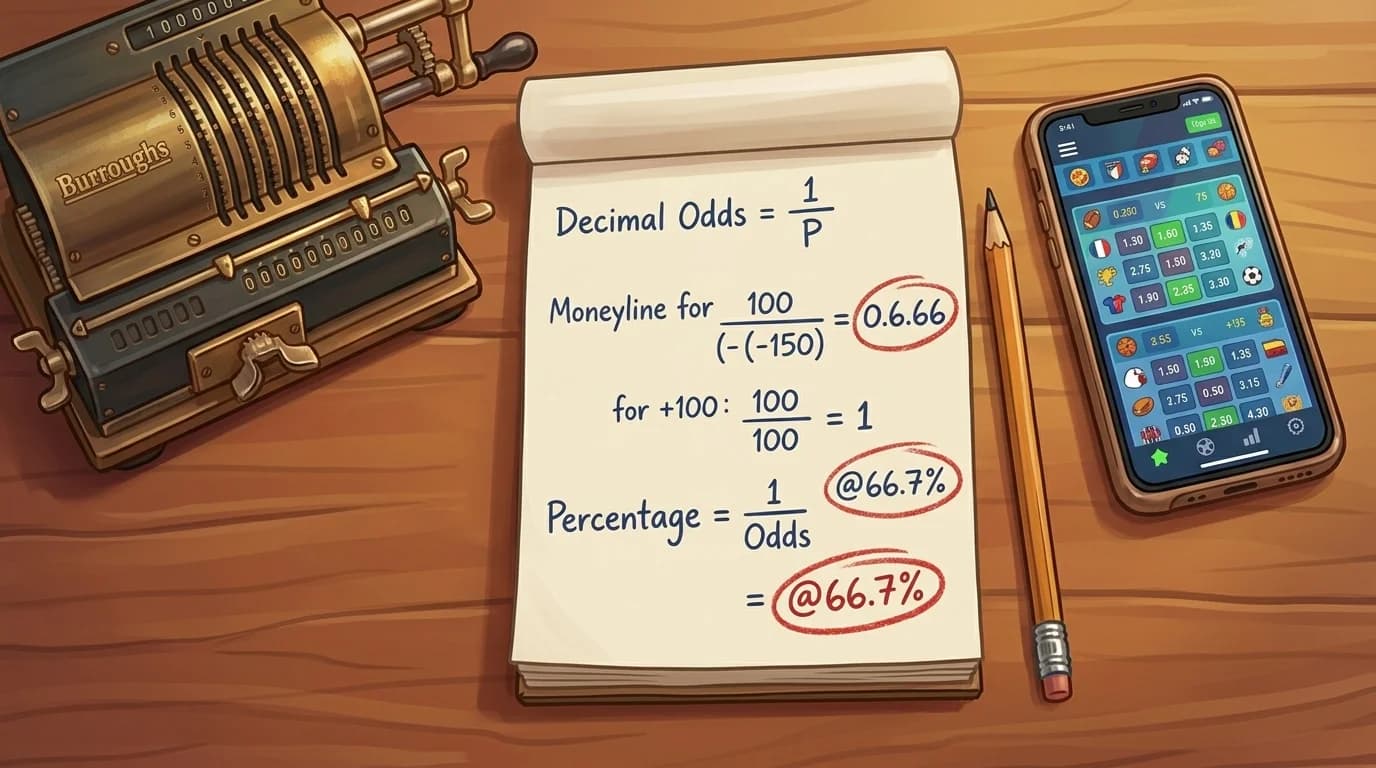
How do different odds formats express the same implied probability?
All odds formats are just different ways of stating the same payout and probability. A 40% implied probability can appear as decimal 2.50, fractional 6/4, or American +150. You do not need to master every format. Convert any price to implied probability, and you have a common baseline for comparing bets across sportsbooks or prediction markets.
What is the difference between implied probability and true probability?
Implied probability is what the market believes. True probability is the actual chance of the event happening—something no one knows until the event resolves. Markets can and do get events wrong. Implied probability also includes the bookmaker's margin, so the total of all outcomes in a market usually sums above 100%. This overround represents the house edge or vig. The market's estimate is a starting point for analysis, not a guarantee of what will occur.
How do prediction markets use implied probability?
In prediction markets, a Yes share priced at $0.65 means the market implies a 65% chance. That is how prediction markets work: prices between $0.01 and $1.00 act as a live probability estimate. On Sides.Trade, you can read the current share price as the market's implied probability for that outcome.
Traders often compare this market-assigned percentage to external data sources. Unlike polls, which collect stated opinions, prediction markets turn expectations into tradable prices that update in real time. When the news changes, the price—and the implied probability—shifts immediately.
Why does implied probability matter for finding value?
Value exists when your personal probability estimate differs from the market's implied probability. If you think an outcome has a 60% chance but the market implies only 50%, the contract may be underpriced relative to your view. That gap is the basis for assessing whether a trade offers fair compensation for the risk. Implied probability is also the starting point for prediction market arbitrage and other pricing strategies. Of course, the market can be wrong, and your estimate can be wrong too. Neither side has a monopoly on accuracy.
Why do market totals exceed 100%?
When you add the implied probabilities of all outcomes in a sportsbook market, the total is typically 104%–110%. That extra percentage is the vigorish, or vig—the bookmaker's built-in margin that ensures profit no matter which side wins. Prediction markets often have lower overrounds because they are peer-to-peer, but fees still matter. Always account for transaction costs when comparing implied probability to your own forecast, because a small edge can disappear after costs.
Quick reference: common odds and implied probabilities
FAQs
Implied probability is the percentage chance of an outcome embedded in betting odds or market prices. It translates a price into what the market believes about the likelihood of an event.
For decimal odds, divide 1 by the odds and multiply by 100. For positive American odds, divide 100 by (odds + 100) and multiply by 100. For negative American odds, divide the absolute odds by (absolute odds + 100) and multiply by 100.
Use the formula that matches your odds format. Decimal: 1 / odds × 100. Positive American: 100 / (odds + 100) × 100. Negative American: |odds| / (|odds| + 100) × 100.
In betting, implied probability shows what chance the oddsmaker or market assigns to an outcome. It reveals whether a wager is priced as likely or unlikely.
It is the same concept applied to athletic events. Sportsbooks set odds that imply a certain win probability, and the total across all outcomes typically exceeds 100% due to the bookmaker's margin.
Odds encode a payout structure, and implied probability extracts the chance those odds represent. A lower implied probability means a bigger potential payout but a lower expected chance of winning.
For positive moneyline odds (+), use 100 / (moneyline + 100) × 100. For negative moneyline odds (-), use |moneyline| / (|moneyline| + 100) × 100.
Select the formula for your odds format—decimal, fractional, or American—and solve for the percentage. All formats express the same underlying probability in different ways.
The extra percentage is vigorish, or vig. It is the bookmaker's built-in margin that ensures profit regardless of which outcome wins.
No. Implied probability reflects market opinion and pricing, not guaranteed results. Markets can be wrong, and prices include fees or margins that distort the true chance.