Prediction Market Calibration and the Brier Score: A Trader's Guide to Measuring Forecast Accuracy

A concise guide to prediction market calibration and Brier score interpretation for traders. Learn the formula, what counts as a good score, and how to use forecasting accuracy metrics to evaluate prediction markets.
- Sides Team
- /July 29, 2026
- /4 min read
Prediction market calibration measures whether a market's stated probabilities match how often those events actually happen over many repeated observations. The Brier score is the standard metric forecasters use to quantify that accuracy, producing a value from 0 to 2 where lower is better.

What is prediction market calibration?
Calibration means that if a contract trades at 70 cents, the underlying event should resolve as "Yes" roughly 70% of the time across a large sample. Before assessing calibration, it helps to understand how prediction markets work: prices aggregate competing beliefs that only become reliable when they are well calibrated. A perfectly calibrated market has no systematic tendency to overstate or understate probabilities. Without calibration, a price of 70 cents gives no reliable signal for position sizing or risk assessment.
What does the Brier score measure?
The Brier score, first introduced by meteorologist Glenn W. Brier in 1950, measures the mean squared error between predicted probabilities and actual binary outcomes. It captures both how close forecasts are to being right and whether confidence levels match real frequencies. It aggregates error across many predictions, so a single lucky guess cannot mask sustained poor judgment. Over many contracts, the score separates skilled forecasters from those who simply got lucky on a few big calls. A score of 0 means perfect accuracy, while 2 means every prediction was exactly wrong.
How is the Brier score calculated?
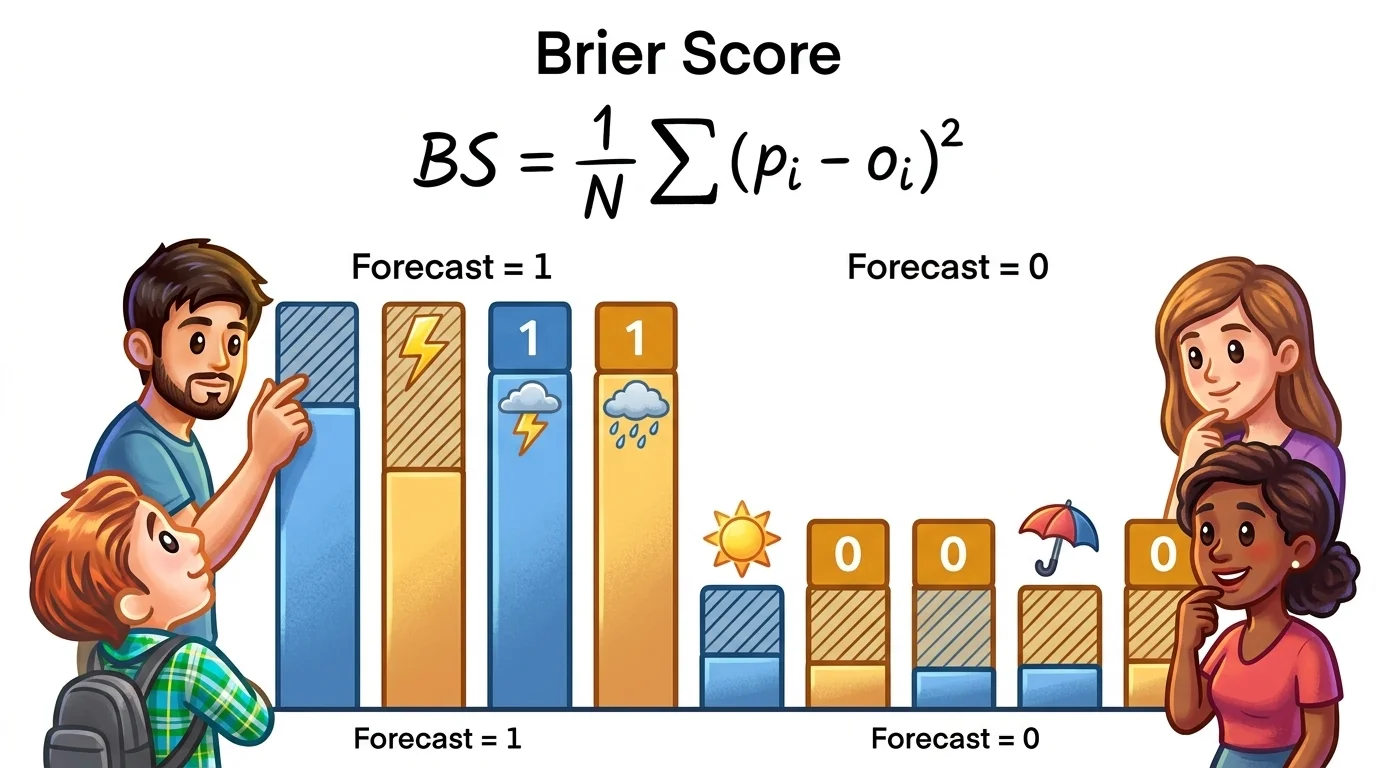
The Brier score formula is BS = (1/N) × Σ(f_t - o_t)², where f_t is the forecasted probability for event t and o_t is the observed outcome (1 if the event occurred, 0 if it did not). For each prediction, subtract the outcome from your probability, square the difference, then average across all forecasts. If you assign an 80% chance to an event that happens, your contribution is (0.8 - 1)² = 0.04. If it fails, it is (0.8 - 0)² = 0.64. This quadratic penalty means overconfident forecasts are punished more heavily than cautious ones, which encourages honest probability reporting. That is why the Brier score remains the default forecasting accuracy metric in competitive leagues and academic studies.
What is a good Brier score?
A good Brier score depends on how predictable the domain is. Perfect accuracy gives 0, while random guessing (50% on every binary event) yields an expected score of 0.25. In competitive forecasting, sustained scores below 0.20 generally indicate strong performance. Because domains differ in predictability, a score that is excellent in geopolitics might be mediocre in weather forecasting. The Brier skill score provides a relative benchmark by comparing a forecaster's result to a naive baseline, such as historical averages or always betting the base rate.
Are prediction markets accurate?
Large-sample studies show that prediction markets often beat polls, expert panels, and statistical models on repeatable domains. Unlike polls, which collect stated opinions, markets require traders to risk capital, which tends to surface better-calculated probabilities. Platform-specific accuracy on Kalshi and Polymarket varies by market type and liquidity, but both exchanges maintain resolved market histories that allow independent Brier score calculation. Accuracy tends to improve as more participants trade and more information enters the price. Researchers regularly find market-implied probabilities closer to realized outcomes than model forecasts or expert consensus.
What is the difference between calibration and accuracy?
Calibration means a forecaster's stated probabilities match observed frequencies over time. Accuracy means the forecaster simply makes more correct calls than incorrect ones. A trader who always predicts 99% on events that happen 85% of the time is accurate but poorly calibrated. Calibration forces honesty about uncertainty; accuracy alone can hide overconfidence. Over the long run, better calibration leads to better decisions even when short-term accuracy looks similar.
How can traders use the Brier score?
Traders can compute their own Brier score across a portfolio of trades to check whether their probability estimates hold up. A rising score after volatile events may mean cognitive biases are distorting judgment, even when news or sentiment reprices the contract rationally. Tracking scores by market category helps traders identify which topics they understand well and which ones to avoid.
A low Brier score measures forecast quality, not trading profitability. It ignores fees, slippage, liquidity, and timing risk, so a well-calibrated trader can still lose money on any given trade. Past accuracy does not guarantee future results. Well-calibrated forecasters have historically outperformed naive estimates. On Sides.Trade, users can follow traders with established low-Brier-score records rather than building calibration entirely from scratch.
What does it mean if a prediction market is poorly calibrated?
Poor calibration means prices systematically overstate or understate true probabilities. If contracts priced at 20 cents actually resolve only 5% of the time, the market is underpricing risk. These gaps often stem from cognitive biases like overconfidence, herd behavior, or availability bias. Identifying poor calibration does not guarantee profits, since markets can stay mispriced until expiration.
FAQs
The Brier score is an accuracy metric that measures the mean squared error between predicted probabilities and actual binary outcomes. It was introduced by Glenn W. Brier in 1950.
Lower is better. A score of 0 means perfect prediction, random guessing yields roughly 0.25 on binary events, and competitive forecasters often sustain scores below 0.20.
For each forecast, subtract the actual outcome (1 or 0) from your predicted probability, square the difference, then average across all forecasts using BS = (1/N) × Σ(ft - ot)².
It measures how closely a forecaster's probability estimates match real-world frequencies and outcomes. It rewards both correctness and appropriately calibrated confidence.
Large-sample evidence shows prediction markets frequently outperform polls and expert panels on repeatable domains. Platform track records on Kalshi and Polymarket support this finding across politics, economics, and sports.
The standard method is to compute the market-implied probability for each contract, record the binary outcome, then calculate the Brier score. Researchers may also use the Brier skill score to compare market accuracy against naive baselines.
Calibration ensures that a contract's price reflects a true probability rather than a biased guess. Without it, traders cannot rely on stated odds for risk assessment.
Traders can track their own Brier scores across trades to audit whether their probability estimates match reality. Platforms like Sides.Trade let users follow forecasters with proven low scores.
It means prices systematically overstate or understate the true likelihood of events. This creates persistent mispricings that calibrated traders may identify.
Calibration means a forecaster's probabilities match observed frequencies over time. Accuracy simply means being right more often than wrong, which can happen even with poorly calibrated extreme predictions.