Explore when prediction markets outperform polls, when surveys provide better insights, and how to use both tools together for sharper political forecasting and market analysis.
- Sides Team
- /April 16, 2026
- /12 min read
The short answer is simple: sometimes prediction markets give a better signal than polls, and sometimes they do not. A market can move faster, absorb fresh information in real time, and punish lazy opinions. A poll can show who supports what, how sentiment splits across groups, and whether public opinion is actually changing. The mistake is thinking both tools do the same job. They do not.
That is why the argument around prediction markets vs polls usually goes wrong from the start. People ask which one is more accurate as if they are comparing two identical instruments. In reality, one measures stated opinion at a given moment, while the other turns expectations into a live price. Those are related signals, but they are not interchangeable.
So the real question is narrower and more useful: when do Prediction Markets produce a sharper read than polls, when do polls hold up better, and what should you make of it when they disagree? That is where the comparison gets interesting, and that is where most readers actually need help.

Prediction Markets vs polls: the short answer
Saying Prediction Markets are more accurate than polls can be true, but only under the right conditions. If a market is active, liquid, and tied to a clearly defined outcome, it can react to new information faster than a poll ever will. Prices move as traders process news, change their positions, and challenge each other's assumptions. In that setup, the market can become a live consensus machine.
A poll still matters because they answer a different question. They tell you what people say they believe, what they plan to do, and how those responses break down across demographics or regions. That kind of structure matters. A clean probability without context can look smart while still hiding what is happening underneath.
So if you want one sentence to carry the whole piece, use this one: prediction markets are often better at pricing fast-moving uncertainty, while polls are often better at showing the shape of public opinion. If both point in the same direction, confidence rises. If they split, the gap itself becomes part of the story.

What Prediction Markets and polls actually measure
Polls are snapshots. They ask a sample of people a question, record the answers, and turn those responses into a picture of opinion at a specific time. That picture can be useful, but it is still a picture. It is not a trade, not a price, and not a running estimate that updates every minute. It is a measured slice of sentiment.
Prediction Markets work differently. A market price reflects what traders are willing to pay based on the probability they assign to an outcome. That sounds obvious, but it changes everything. A poll respondent can answer casually. A trader has to live with the position. That difference becomes clearer once the basic structure is clear: polls collect stated opinions, while prediction markets turn expectations into tradable prices.
The mechanics matter too. A market is not just a crowd shouting opinions. It is a place where price changes because participants buy, sell, hedge, react, and correct. The comparison depends on incentives and price formation, not just on headlines.

Why Prediction Markets can be more accurate than polls
The strongest case for markets starts with incentives. When money is on the line, sloppy conviction becomes expensive. People can still be emotional, biased, or overconfident, but the market gives those errors a cost. A bad take in a conversation is free. A bad take in a position is not. That changes behavior.
The second edge is aggregation. Polls gather answers from respondents. Markets gather information from participants who may be reacting to polling, news, onchain chatter, sector flows, campaign developments, rumors, or data that never makes it cleanly into a survey question. When that information enters price through many hands, the market can compress scattered signals into one number.
The third edge is speed. Polls arrive in waves. Markets move continuously. If something meaningful happens at 10 a.m., the market can react before lunch. A poll cannot. That does not mean the market is always right. It means the market is often faster, and in some environments speed is a huge part of accuracy.

Why polls still matter
Polls are not obsolete because they do something markets usually cannot: they show the composition of opinion. You can see age splits, regional splits, party shifts, turnout concerns, and softness in support. A market price does not explain any of that by itself. It gives you a signal, not a map.
Polls also help frame what the market is responding to. Traders do not operate in a vacuum. They watch polling, interpret it, and often price around it. That means a market is sometimes ahead of surveys, sometimes merely digesting them, and sometimes overreacting to them. If you ignore polls completely, you miss part of the input stream shaping the market in the first place.
There is also a practical point here. Not every reader needs a real-time probability. Sometimes the real question is simpler: which group is moving, where is support softening, or how stable is sentiment over time? In those moments, a poll can be more informative than a price chart, even if the chart looks more exciting.

Prediction Markets vs polls: the key differences that matter
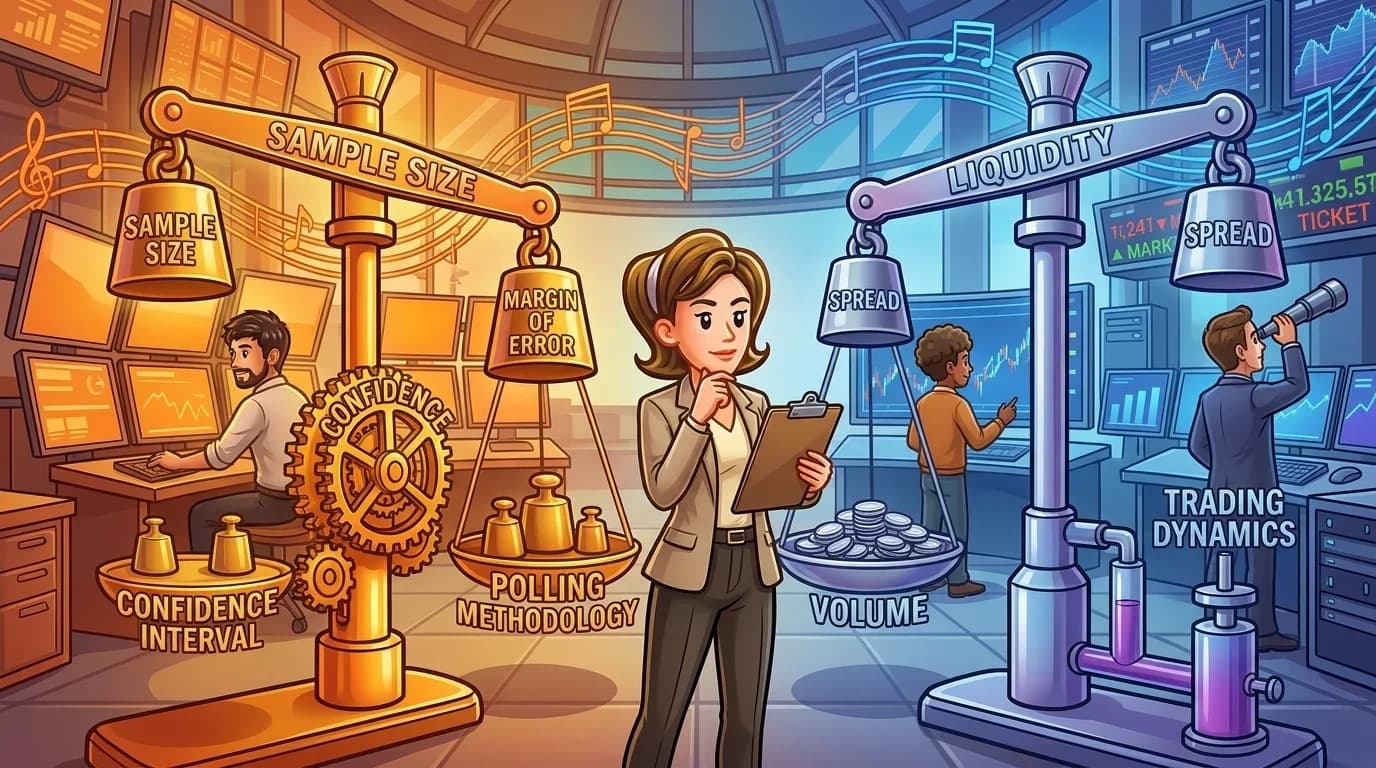
The cleanest way to compare Prediction Markets vs polls is to look at what drives each one. Polls depend on sampling quality, question design, timing, and response patterns. Markets depend on liquidity, participation, information flow, and market structure. Both can fail. They just fail for different reasons.
That difference also changes how you should read each signal. If you are looking at a market price, you are looking at implied probability. That requires some fluency with pricing logic. The same pricing logic appears in betting odds: a number can express both potential return and perceived likelihood
A market moving from 40% to 52% represents a 30% increase in perceived probability, not just a 12-point shift.
The reading gets easier once you stop treating prices as abstract percentages and start seeing them as live probability lines. Understanding odds-style formats can also make prediction market prices easier to interpret. The surface language changes from platform to platform, but the core idea stays the same: the line is telling you how the market currently prices an outcome.
When Prediction Markets are more useful than polls
Markets tend to shine when information moves fast and when the outcome is clear enough to settle cleanly. If the event has defined terms, enough traders, and active repricing, the market can pick up on shifts before a new survey cycle even starts. In those cases, the value is not just the number itself. It is the speed of the change.
They also tend to be stronger closer to an event. As uncertainty narrows and information improves, prices can become sharper. The market still will not become magic, but it can become more disciplined. A late-stage market with meaningful participation often says more than a stale poll taken days earlier.
This is also where readers confuse Prediction Markets with adjacent formats. A sports line and a prediction contract can feel similar on the surface, but the context is different. The distinction is clearer when you compare purpose, structure, and information flow rather than surface similarities.

When polls can be more useful than Prediction Markets
Polls are more useful when markets are thin. If only a small number of participants are trading, the price may look precise while actually carrying weak information. Low-volume markets can be jumpy, easy to distort, and heavily shaped by a few actors. A poll with a decent methodology may be boring, but boring can still beat noisy.
Polls are also more useful when the real story lives inside the breakdown. If you need to know why support is moving, which bloc is changing, or how a subgroup is behaving, a single market line will not do the job. It can tell you where expected probability sits. It cannot explain the machinery underneath unless you pair it with other data.
There is a subtler point too. Sometimes the market price is basically a market reaction to polling. In that case, the market is not adding much independent value. It is repackaging the same information through trading behavior. That does not make it useless, but it does mean the "market beat the polls" argument can get overstated.
Why Prediction Markets sometimes get it wrong
The first reason is low liquidity. A market with weak depth can produce prices that look authoritative but are actually fragile. Small trades move the line too much, confidence gets overstated, and noise starts pretending to be insight. Many bad reads start there.
The second reason is structural friction. Fees, limited participation, platform constraints, and awkward market design can all create distortions. A price is never pure truth. It is the result of a mechanism. That is why arbitrage matters because price gaps reveal where the market may be less efficient than it looks. It reveals where prices can drift away from fair value and where the market is less efficient than it looks.
The third reason is bad contract design. If the resolution language is vague, disputed, or easy to misread, the signal degrades fast. Traders stop arguing about the event and start arguing about settlement. That is exactly why contract wording matters because unclear settlement rules can weaken the entire signal. It sits at the center of whether a Prediction Market deserves trust at all.

Why polls sometimes get it wrong
Polls fail for their own reasons. They can miss mood shifts, capture stated intent without future action, and overstate the confidence of a snapshot. Public opinion is not fixed. It changes, and it changes unevenly. By the time the result is published, the underlying picture may already be moving.
Methodology can also create distance between the poll and the outcome. Sample quality, turnout assumptions, question wording, response bias, and timing all shape the final number. None of that means polls are fake. It means they are constructed instruments, not raw reality.
The deeper issue is that a poll records what people say when asked. That matters, but it does not always translate into what happens next. Events intervene. Narratives shift. Participation changes. And once those conditions move, the poll becomes less like a forecast and more like a dated photograph.

The smartest approach is often to use both together
The strongest readers do not force a winner where no winner exists. They treat polls as one layer and markets as another. Polls show the shape of sentiment. Markets show the priced expectation of an outcome. Put those together, and you get a fuller view than either one gives alone.
This matters most when the signals line up. If polls point one way and the market reinforces the same direction, confidence usually increases. The story becomes cleaner. The read is not automatically correct, but it becomes easier to trust because separate tools are landing near the same conclusion.
It matters just as much when the signals split. That is not always a flaw. Sometimes disagreement is the real information. A steady poll and a moving market can tell you traders are processing something the survey has not absorbed yet. A stable market and a noisy poll can tell you the opposite. Used together, the tension becomes useful.

How to read disagreement between Prediction Markets and polls
If the market moves first, start by asking what new information may be getting priced in. It could be fresh news, a reinterpretation of old data, changes in turnout expectations, or simply a faster reaction cycle. Markets do not need a full survey process to move, so they often register changes earlier.
If polls move and the market does not, ask whether the market sees those results as noisy, incomplete, or already priced. Traders do not respond to every data point with equal weight. Sometimes the market shrugs because the information is not that new. Sometimes it waits for confirmation. Sometimes it is wrong to stay calm.
If the gap stays wide, resist the urge to declare one side the winner too early. A split between markets and polls can signal uncertainty more than superiority. It can mean the evidence is mixed, the event is still unstable, or the most visible number on your screen is less conclusive than it looks.

Regulation matters more than casual readers think
No comparison between markets and polls is complete without structure, and structure includes rules. Access, contract design, limits, enforcement, and platform-level restrictions all shape who participates and how prices form. That means regulation is not an abstract legal side note. It affects signal quality on the ground.
This is especially obvious in the United States, where market design has often been shaped as much by regulatory boundaries as by product ambition. Once you fold US regulation also affects who can participate, how markets are structured, and how reliable the resulting price may be, it becomes easier to see why some markets stay thin, why some products look more cautious than others, and why not every price reflects the same level of open competition.
That does not make regulated markets weak by default or looser markets strong by default. It just means the context around the price matters. A number on a screen is only as good as the market environment that produced it.

So which should you trust more?
Trust Prediction Markets more when the market is active, the event is clearly defined, the information flow is fast, and enough participants are involved to keep pricing honest. In that environment, markets can do what polls struggle to do: move quickly without waiting for a new survey wave.
Trust polls more when you need to understand the structure of opinion, when the market is thin, or when the main question is not just "what is the probability?" but "who is moving, where, and why?" In those moments, detail beats speed.
Trust both most when they agree, and treat disagreement as a signal worth studying rather than a nuisance to flatten. That is the most grounded answer to the whole prediction markets vs polls debate. One tool is not replacing the other. Each becomes more useful when you know what it is actually telling you.

Final thought
A lot of content around this topic tries to force drama into a comparison that works better with nuance. Prediction Markets vs polls is not a cage match. It is a question of tool fit. If you ask the wrong question, both tools can look worse than they are.
The better approach is simple. Know what each one measures. Know what can distort each one. Know when speed matters more than structure and when structure matters more than speed. Once you do that, the comparison stops being a slogan and starts becoming useful.
FAQs
Sometimes they are, especially in active markets that react quickly to new information. But that does not make them universally better. Accuracy depends on _liquidity, contract clarity, and participation_.
Because traders use polling as one of their inputs. A market can lead, lag, or simply digest survey data, depending on the moment and the event.
They should be read with caution. A thin market can look confident while carrying weak information and unstable pricing.
No. Polls collect stated opinions. Markets price expected outcomes through trading behavior. The signals overlap, but the method is different.
Because the same logic that helps readers understand implied probability also helps them read prediction prices more accurately. That is why the bridge between market prices and betting-style formats is more practical than it first appears.
It matters because price gaps reveal when a market is less efficient than it seems. In that sense, arbitrage is not just a tactic. It is also a clue about market quality.
No. The cleanest answer is conditional. Markets are often stronger at rapid repricing. Polls are often stronger at structured measurement. The better tool depends on what exactly you are trying to know.
Because a market cannot produce a trustworthy price if participation is distorted or the outcome itself is unclear. Rules and resolution design shape the quality of the signal.