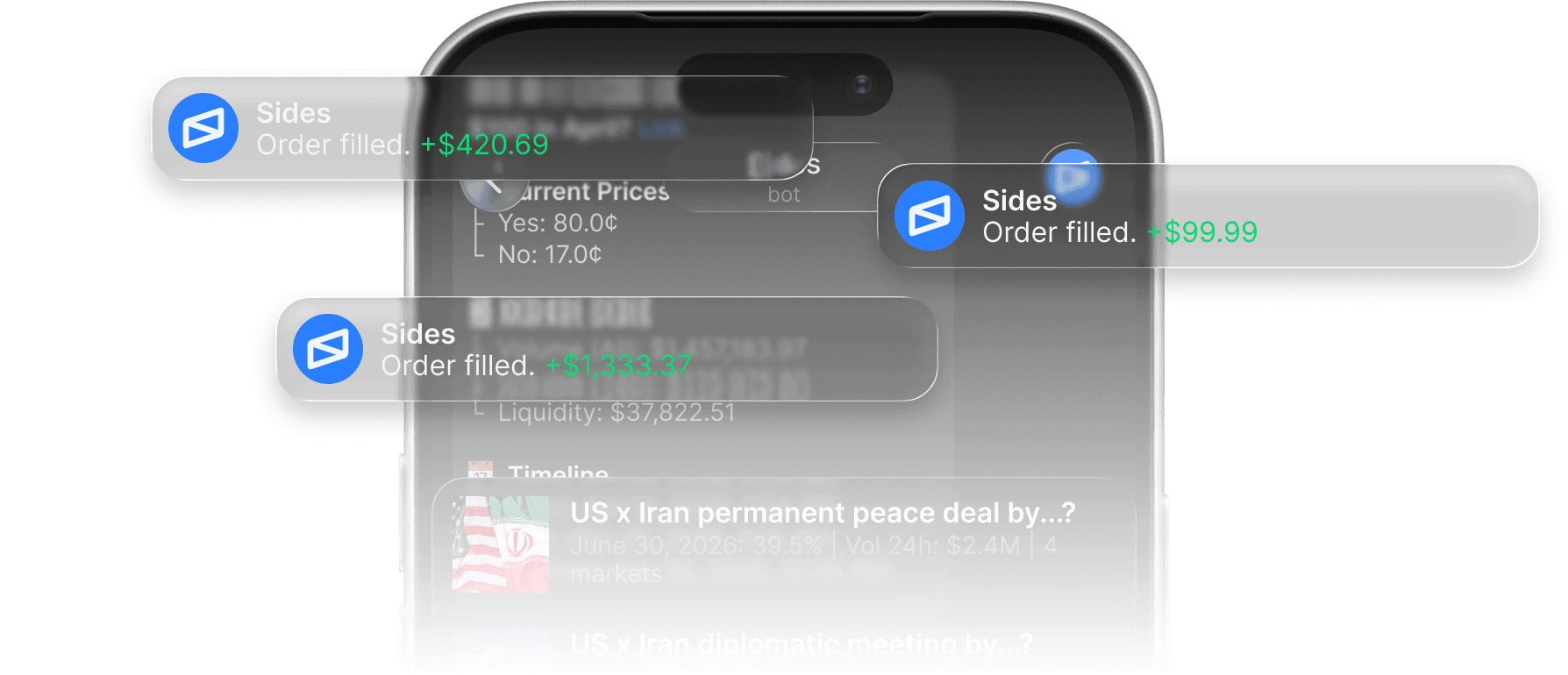
What is Copy Trading?

A beginner-friendly guide to copy trading: meaning, examples, automatic vs manual copying, trader selection, safety, risks and strategy basics.
- Sides Team
- /April 30, 2026
- /22 min read
Copy trading is one of those terms that sounds more complicated than it is. In simple words, it means following another trader's positions instead of making every trading decision alone. A user chooses a trader, strategy, wallet or profile to follow, then their own account repeats some or all of that trader's activity.
That is the short answer. But the real meaning goes a little deeper. But the real meaning goes a little deeper. Copy trading can be automatic, where the platform mirrors trades for the user, or manual, where the user watches another trader's actions and decides whether to repeat them. Either way, the idea is the same: one person uses another trader's market decisions as a signal.
Copy trading is popular because it lowers the entry barrier. A beginner does not need to build a full strategy from day one. They can observe how experienced traders behave, what positions they enter, when they exit, and how their decisions play out in real markets. Still, copy trading is not a shortcut to guaranteed profit. If the copied trader loses money, the copier can lose money too.

What is copy trading?
Copy trading is a trading method where one user copies the trades of another trader. The person being copied is often called a copied trader, strategy provider or signal provider. The person following them is usually called a copier or follower. In most cases, the copier decides how much money to allocate, while the platform handles the trade execution based on the copied trader's activity.
A simple copy trading definition would be this: copy trading is the practice of repeating another trader's positions, either automatically or manually, in your own account. This can include the same market, the same direction, similar position sizing, entry timing, exit timing, or a proportional version of the original trade.
For beginners, copy trading can feel like a more approachable way to enter trading. Instead of trying to understand every market move from scratch they see a market move, users can watch real decisions happen in context. But it is important to understand that copying a trader does not mean copying their experience, discipline or risk tolerance. You are repeating the action, not inheriting the full reasoning behind it.
Copy trading definition
The core meaning of copy trading is simple: one trader makes a decision, and another user follows that decision. If the original trader opens a position, the copier may open a similar one. If the original trader closes it, the copied position may close too. The trade size can be identical or adjusted based on how much capital the copier has allocated.
Most beginners are trying to understand whether copy trading is a tool, a strategy, or a passive investment method.This is why the phrase what is copy trading how it works matters
It does not remove market risk. It also does not guarantee that the copied trader knows what will happen next. Copy trading simply lets one user follow another trader's activity more directly than reading posts, signals or market commentary.
What does copy trading mean for beginners?
For beginners, copy trading means access to real market behavior without needing to make every decision from scratch. A new user can see how a more experienced trader handles entries, exits and changing market conditions. That makes copy trading for beginners attractive, especially for people who want to learn by watching actual trades instead of only reading theory.
But beginners should not treat copy trading as a magic button. The copied trader may have a different portfolio size, a different risk appetite and a different reason for entering a position. A trade that makes sense for one person may be too risky for another.
This is why what is copy trading and is it safe for beginners is one of the most important questions around the topic. Copy trading can be beginner-friendly, but it is not automatically safe. It is still trading, and trading always carries the risk of loss.
Key terms in copy trading
A copier is the user who follows another trader. A copied trader is the person whose trades are being followed. Some platforms call this person a strategy provider or signal provider, especially when their role is to share trading activity that other users can mirror.
A copied trade is the actual position repeated by the follower. Allocation means the amount of money assigned to copy a specific trader or strategy. If a user allocates $100 to a copied trader, the platform may size copied positions proportionally based on that amount.
Automatic copy means the platform repeats trades for the user once the copy relationship is active. Manual copy means the user sees another trader's signal or position and decides whether to enter on their own. Both versions fall under copy trading, but they give the user different levels of control.

How does copy trading work?
Copy trading works by connecting one user's account to another trader's activity. When the copied trader opens a position, the copier's account can repeat that position. When the trader closes or changes the position, the copied trade may also change, depending on the platform and settings.
That is the basic answer to how does copy trading work. The copier does not usually hand money directly to the trader. Instead, the platform creates a link between the copied trader's actions and the copier's account. The copier keeps their own funds, but their trades follow someone else's decisions.
Results can still differ between the copied trader and the copier. Timing, liquidity, fees, spreads and execution can affect the final outcome. If the copied trader enters earlier at a better price, the copier may receive a worse entry. If the market moves quickly, even a small delay can change the result.
Automatic vs manual copy trading
Automatic copy trading means the system repeats trades without the user approving every single action. This is the version many people think of when they ask how copy trading works. It is convenient because the user does not need to sit in front of the screen all day.
Manual copy trading gives the user more control. The user sees a trade, signal or public position, then decides whether to follow it. This can be slower, but it gives the copier more room to reject trades that do not fit their own risk level or market view.
Neither version is perfect. Automatic copy trading is easier, but it can make users passive. Manual copy trading gives more control, but it requires more attention and faster decisions.
What actually gets copied?
What gets copied depends on the platform. In some systems, only the trade direction is copied. If the trader buys, the copier buys. If the trader sells, the copier sells. In other systems, position size, entry price, exit timing and portfolio allocation may also be mirrored.
In many cases, copied trades are proportional. If the original trader uses 10% of their portfolio for a position, the copier may use 10% of the amount they allocated to that trader. This keeps trade sizing more balanced between accounts with different capital.
That is why the mechanics matter. Copy trading is not just copy and profit. It is a system of trade replication, and the details of that replication can change the final result.

Copy trading example
Imagine a trader opens a position on Bitcoin, a stock, a forex pair or an event market. A copier has allocated $100 to follow this trader. If the trader opens a position using 20% of their portfolio, the copier may open a proportional position using $20 from their allocated amount.
If the market moves in the trader's favor and the position closes in profit, the copier may also make a profit. If the market moves against the trader and the position closes at a loss, the copier may lose money too. Copy trading repeats exposure to the decision, not just the good parts.
This is the simplest way to understand copy trading explained through an example. The copier does not need to create the original trade idea, but they still share the outcome of that idea.
Example of a winning copy trade
A copied trader buys an asset at $100 and sells it later at $110. The trade makes a 10% gain before fees. If a copier followed that trade with proportional sizing and similar execution, their copied position may also end in profit.
The exact result may not be identical. Fees, timing and entry price can change the final return. Still, the general direction is the same: the original trader made a profitable decision, and the copier benefited from following it.
This is the part of copy trading that attracts many users. They want exposure to someone else's trading skill, especially if that trader has a visible history of strong decisions.
Example of a losing copy trade
Now imagine the copied trader buys at $100, but the market drops to $90. The trader closes the position at a loss. The copier follows the same trade and also loses money, adjusted for their own position size and execution.
This is where many beginners misunderstand copy trading. A copied position can lose just as easily as it can win. The fact that another trader made the decision does not make the trade safer by default.
A losing example is important because copy trading should not be framed as passive income. It is still market exposure. The copier is not only copying the upside. They are also copying the downside.

Why do people use copy trading?
People use copy trading because it makes trading feel more accessible. Instead of analyzing every chart, market, event or news update alone, the user can follow someone who appears to have more experience. This can reduce the pressure of making every decision from zero.
Another reason is time. Many users want market exposure, but they do not want to spend hours researching every position. Copy trading gives them a way to participate while relying on another trader's activity as a starting point.
There is also an educational angle. Watching real trades can teach users how traders behave in live conditions. A textbook can explain theory, but copied trades show how decisions look when money, timing and uncertainty are involved.
Lower barrier to trading
Copy trading lowers the barrier because it reduces the amount of initial knowledge required to participate. A beginner does not need to understand every indicator, market signal or trading setup before seeing how trades happen in practice.
That does not mean the user can avoid learning forever. It only means copy trading can make the first step less intimidating. The copier can observe patterns, compare traders and slowly understand why some decisions work better than others.
This is why copy trading often appears in beginner-focused content. It gives new users a structure. But the structure only helps if the user remembers that copied trades still carry real financial risk.
Learning from real market decisions
Copy trading can be educational because it shows action, not just theory. Users can watch when a trader enters, how long they hold, when they exit and how they react to changing conditions.
This can be especially useful in fast-moving markets, where timing matters. A copied trader's behavior can reveal whether they are patient, aggressive, reactive, disciplined or simply lucky.
For users who want to understand trading, this real-time exposure can be valuable. But learning only happens when the copier pays attention. Blind copying teaches very little.
Time efficiency
Time efficiency is another major reason people use copy trading. Not everyone wants to spend the day monitoring charts, order books, news feeds or market comments. Copy trading can reduce the amount of manual work needed to stay active.
This does not make it fully passive. The user still needs to understand what they are exposed to. They also need to know that market conditions can change, and a trader who performed well before may not perform well later.
Copy trading saves time compared with fully manual trading, but it does not remove responsibility. It simply changes where the user spends attention.

Benefits of copy trading
The main benefit of copy trading is accessibility. It gives users a way to participate in markets without having to build a full trading framework immediately. For beginners, that can make the difference between being completely lost and having a visible reference point.
Another benefit is exposure to different trading styles. One copied trader may focus on short-term moves. Another may prefer longer positions. A third may specialize in event-based markets. By watching different approaches, users can better understand how trading behavior changes across markets.
Copy trading can also support diversification, depending on the platform. A user may follow more than one trader or market type instead of relying on a single idea. That does not remove risk, but it can make exposure less dependent on one decision-maker.
Easier access for beginners
For beginners, the biggest benefit is clarity. Copy trading gives them something concrete to observe. Instead of reading abstract explanations, they can see actual positions and outcomes.
This is why many beginners want a plain-language explanation before they start copying trades. Many users are not looking for complex theory. They want a plain answer to what is happening when one trader copies another.
Copy trading gives that answer in action. A trader enters, the copier follows, and the result becomes visible.
Less manual research
Copy trading can reduce the need for manual research before every position. The copied trader does the original analysis or makes the original decision. The copier uses that decision as a signal.
This is useful for people who do not have time to track every market themselves. It can also help users discover markets or trading styles they would not have found alone.
Still, less research does not mean no research. A copier who never checks what they are following can end up taking risks they do not understand.
Exposure to different strategies
Copy trading can expose users to different strategies, markets and time horizons. One trader may focus on crypto. Another may trade forex, stocks or commodities. In Prediction Markets, another trader may focus on politics, sports, macro events or crypto-related outcomes.
This variety can make copy trading more flexible than simply following one signal channel. Users can compare how different traders behave under pressure and how their results change over time.
But variety can also create confusion. More strategies do not automatically mean better outcomes. The user still needs to understand what kind of behavior they are copying.
Educational value
The educational value of copy trading comes from observation. A user can see how real trades develop, how losses happen and how profitable positions are managed. That can be more useful than only reading theory.
For example, a copied trader might close a winning position early, hold through volatility or cut a loss quickly. Each decision shows the copier something about risk, timing and conviction.
The problem appears when users stop thinking. If a copier treats every copied trade as correct, the learning value disappears. Copy trading is most useful when it sparks questions, not when it replaces judgment entirely.
Portfolio diversification
Some users treat copy trading as a way to diversify across traders. Instead of relying on one person, they may follow several profiles with different styles. This can spread exposure across markets, timeframes and decision-making patterns.
Diversification does not guarantee safety. Several traders can be wrong at the same time, especially if they are exposed to similar markets. But it can reduce dependence on one trader's behavior.
This is one reason copy trading remains popular. It can feel more structured than random trading, especially when users can compare performance, risk and market focus across multiple traders.

Risks and limitations of copy trading
The biggest risk is obvious but often ignored: you can lose money. Copy trading does not remove market risk. If the copied trader enters a bad position, holds too long or misreads the market, the copier can suffer the same result.
Another limitation is reduced control. In manual trading, every decision belongs to the user. In copy trading, the original decision comes from someone else. The copier may not know why a trade was opened, what information the trader used or when the trader plans to exit.
There are also technical and structural risks. Execution delays, spreads, fees and liquidity can make the copier's result worse than the original trader's result. This matters even more in fast-moving or thin markets.
You can lose money
Copy trading is still trading. That means losses are part of the system. A copied trader can be experienced and still make bad calls. Markets can move against any position.
This is why copy trading should never be understood as guaranteed income. The copier is not buying certainty. They are following someone else's exposure.
If a trader takes aggressive risks, the copier may inherit those risks without fully understanding them. That can be dangerous, especially for beginners.
Past performance can be misleading
A trader's past performance can look impressive, but it does not prove future results. A strong record may come from skill, but it may also come from luck, one market cycle or a few oversized winning positions.
This is one of the easiest traps in copy trading. Users see high returns and assume the trader has a repeatable edge. Sometimes that is true. Sometimes the trader simply had a good run.
Past performance is useful context, but it should not be treated as a promise. Markets change, and trading styles can stop working.
You have less control
Copy trading gives up some control. The user may not decide the exact entry, timing or exit. In automatic systems, those actions can happen without manual approval.
This can be useful for speed, but it can also make the user feel disconnected from the risk. A position may open before the copier fully understands why.
Less control is not always bad, but it needs to be acknowledged. A copier should know that they are following someone else's judgment, not making a fully independent decision.
Results may differ from the original trader
A copied trader and a copier may not get the same result. The original trader might enter at a better price. The copier might enter a few seconds or minutes later. Fees or spreads may also reduce returns.
Liquidity matters too. If the market is thin, the copied position may be harder to enter or exit at the same price. This can create a gap between the trader's performance and the copier's performance.
This is one reason how does copy trading work should never be answered only with it copies trades. The mechanism matters because small differences can change the outcome.
Trader incentives may differ
Not every trader has the same incentive as the copier. Some traders may earn from followers, subscriptions, visibility or volume. That does not automatically make them bad, but it means incentives can differ.
A trader may take risks that make their profile look attractive in the short term. High returns can draw attention, even if the underlying risk is too high for many followers.
This is why users should avoid treating popularity as proof of quality. A copied trader can be visible, charismatic and profitable for a while, but still risky to follow.

Is copy trading safe for beginners?
Copy trading can be useful for beginners, but it is not fully safe. A beginner may benefit from watching experienced traders, learning market behavior and seeing real decisions unfold. At the same time, they can lose money if they copy poor decisions or misunderstand the risk.
Whether copy trading is safe for beginners depends on several factors. It depends on the platform, the transparency of trader data, the market being traded and the user's own expectations. A careful beginner may use copy trading as a learning tool. A careless beginner may treat it like a shortcut and get burned.
The safest mindset is simple: copy trading can make trading easier to observe, but it does not make markets predictable. Beginners should understand that copied trades can fail, even when the copied trader looks experienced.
When copy trading can be useful for beginners
Copy trading can be useful when it helps beginners understand real market behavior. Seeing trades open and close can make abstract ideas more concrete. It can also help users learn how different traders manage risk and timing.
It can also be useful when the platform provides clear information. Transparent trade history, visible performance, open positions and risk metrics make it easier to understand what is being copied.
In that case, copy trading becomes more than blind following. It becomes a way to observe, compare and learn from real activity.
When copy trading becomes dangerous
Copy trading becomes dangerous when users copy without thinking. High returns, social hype or a polished trader profile can make a risky strategy look safer than it is.
It is also dangerous when users do not understand the market they are entering. Copying a crypto trader, forex trader or prediction market trader without knowing the basic mechanics can lead to confusion and poor decisions.
The biggest danger is believing that someone else can remove responsibility. Copy trading shifts the source of the trade idea, but the risk still lands in the copier's account.
Copy trading vs manual trading
Manual trading means the user makes every decision alone. They research the market, choose the position, decide the size, enter the trade and close it. This gives more control, but it also requires more knowledge, time and emotional discipline.
Copy trading is different because the original decision comes from another trader. The copier may still choose who to follow and how much to allocate, but they are not creating every trade idea independently.
The trade-off is clear. Manual trading gives more independence. Copy trading gives easier access and a reference point, but less direct control. Both can lead to gains. Both can lead to losses.
Copy trading vs social trading vs mirror trading
Copy trading, Social Trading and Mirror Trading are related, but they are not the same. Copy trading focuses on repeating another trader's positions. The main idea is execution: one trader acts, another follows.
Social trading is broader. It can include public feeds, trader discussions, shared ideas, comments, leaderboards and community signals. A user may learn from other traders without copying their positions automatically.
Mirror trading is usually more system-based. Instead of following a person's individual trades, the user may mirror a predefined strategy or portfolio. It is often more automatic and less flexible than social trading.
Copy trading repeats another trader's trades with medium user control. Social trading lets users learn from public ideas and discussions with high user control. Mirror trading follows a predefined system or portfolio with low to medium user control.
What is copy trading in Polymarket and Prediction Markets?
Copy trading in Polymarket and Prediction Markets has its own flavor. Instead of copying a normal asset trade, the user may copy a position on an event outcome. For example, a trader may buy YES or NO on whether a political, sports, crypto or macro event will happen. A copier follows that same market view.
This difference matters because prediction markets are built around event outcomes, not just asset prices. A prediction market is built around event outcomes, not just asset prices. The position is tied to whether something happens, resolves in a certain way or reaches a specific condition.
The mechanics also change: the price often reflects implied probability, so copying a trade means copying both a market view and an entry price. The price often reflects implied probability, so copying a trade means entering a view on both the event and the current odds.
How copy trading differs in Prediction Markets
In traditional markets, copied trades often involve assets like stocks, currencies or crypto tokens. In Prediction Markets, the copied position is usually tied to an event contract. That means the trader is not just saying this price will go up. They are taking a position on an outcome.
Event contracts are central here because the copied position is tied to a specific outcome and settlement rule.
This changes the way risk feels. A copied position can be correct or wrong based on the final resolution, not only on short-term market movement. Timing still matters, but the event outcome matters even more.
Why Polymarket copy trading has its own risks
Polymarket-style copy trading can be affected by odds movement. If a trader buys YES at 40 cents and the copier enters later at 60 cents, they are not taking the same risk-reward profile. The market view may be similar, but the price is different.
Odds and prediction market prices both express implied probability, but the entry price still changes the risk-reward profile.
For users coming from sports betting, moneyline-style thinking can help translate market prices into implied probability.
Different platforms can show probability, decimal odds, fractional odds or American odds. That is why odds formats in betting are useful context for anyone comparing prediction markets, sports markets and copy trading interfaces. The format may change, but the user still needs to understand what the price implies.
Prediction markets also sit close to sports betting in the eyes of many users, but they are not identical. The distinction from sports betting also matters because prediction markets involve tradable event contracts, liquidity, market prices, and resolution rules.
There is also a legal and compliance layer. Prediction market regulation in the US affects which platforms operate, what users can access and how event-based markets are treated. That context matters when discussing Polymarket, copy trading tools and US users.
Finally, some advanced users connect copy trading with price differences between markets. Advanced users may also compare price differences across prediction markets, but that is separate from basic copy trading.

Is copy trading a strategy?
Copy trading can be part of a strategy, but it is not a full strategy by itself. It is better described as a trading method or execution model. The user is choosing to follow another trader's decisions, but the quality of the strategy depends on what kind of trader is being copied.
This matters because two users can both use copy trading in completely different ways. One may follow a conservative trader with slow, low-risk positions. Another may follow an aggressive trader who takes large bets on volatile markets. Both are using copy trading, but they are not following the same kind of strategy.
If someone treats copy trading as a strategy, the answer should be careful.
Is copy trading right for everyone?
Copy trading may fit users who want a simpler way to understand trading, observe real market decisions and reduce the amount of manual research they need to do. It can also fit people who are comfortable learning through real outcomes, including losses.
It may not fit users who expect guaranteed returns, dislike uncertainty or do not want to understand risk at all. Copy trading still requires basic awareness of the market, the copied trader and the possible downside.
The better question is not is copy trading good or bad? The better question is whether the user understands what they are copying. Copy trading can be useful when it supports learning and structured exposure. It becomes risky when it replaces thinking completely.
Final thoughts: what copy trading really means
Copy trading means following another trader's market decisions through your own account. It can make trading more accessible, especially for beginners who want to observe experienced traders in action. It can also save time and help users understand different trading styles.
But copy trading does not remove risk. A copied trader can be wrong. Execution can differ. Fees, timing and liquidity can change the final result. Past performance can look attractive without proving that future trades will work.
The cleanest way to think about copy trading is this: it is not about turning off your brain and trusting someone else with the market. It is about using another trader's activity as a signal while still understanding the risk behind every copied position.
FAQs
Copy trading is a trading method where a user follows or repeats another trader's positions. The copied trades can happen automatically through a platform or manually based on visible signals, wallets or public trading activity.
The meaning of copy trading is simple: instead of making every trading decision alone, a user copies another trader's actions. This can include trade direction, entry, exit, position size or broader portfolio behavior, depending on the platform.
Copy trading works by linking a copier's account to a trader, strategy or wallet. When the selected trader opens or closes a position, the copier's account can repeat the same action, often with proportional trade size.
Copy trading can be useful for beginners because it gives them a visible way to observe real trading decisions. But it is not risk-free, and beginners can still lose money if the copied trader performs poorly or takes too much risk.
Copy trading is not fully safe because it still involves market risk. Safety depends on the platform, trader transparency, market liquidity, fees, execution and the user's own understanding of the copied exposure.
Yes. If the trader you copy loses money, you can lose money too. Your result may also differ from the original trader because of timing, fees, spreads, liquidity or execution delays.
Manual trading means the user researches, opens and closes every trade independently. Copy trading means the user follows another trader's positions, either automatically or manually, while still keeping the risk in their own account.
Copy trading repeats another trader's positions. Social trading is broader and usually includes watching ideas, discussions, public portfolios and trader commentary without automatically copying every trade.
Copy trading in Polymarket means following traders, wallets or positions in prediction markets. Instead of copying a standard asset trade, the user may copy a YES or NO position on an event-based market.
Copy trading is more of a trading method than a complete strategy. The actual strategy depends on the trader being copied, the market, risk level, position sizing and time horizon.